



The U.S. authorization of Johnson & Johnson’s Ottava surgical robot, announced last week, came earlier than analysts were expecting and on the eve of a major robotic surgery conference, setting the industry abuzz.
The Food and Drug Administration’s de novo authorization covers multiple general surgery procedures in the abdomen.
J&J is betting its depth of surgical experience and the platform’s unique design will appeal to surgeons and health systems in an increasingly crowded robotic surgery field that market leader Intuitive helped create 25 years ago.
J&J’s robot design differs from cart-based soft tissue surgical systems such as Intuitive’s da Vinci and Medtronic’s Hugo with the integration of four “intelligent” arms directly into the operating table, according to J&J’s Rocco De Bernardis, global president of Ottava.
Robotic surgery’s newest entrant brings J&J’s legacy of instrumentation expertise and tissue management science to reduce patient complications, De Bernardis said, and is combined with the company’s digital ecosystem, Polyphonic, to drive surgical learning and serve as an open, secure platform for future innovation.
“To do all that, as you can imagine, it has taken the best of the engineering minds,” said De Bernardis. “We took a very complex engineering problem to give simplicity back to the surgeons and the surgical teams.”
De Bernardis, a mechanical engineer by training, described the elements of Ottava that set the system apart in a conversation with MedTech Dive.
This interview has been edited for length and clarity.

Rocco De Bernardis, J&J’s global president of Ottava, is a mechanical engineer by training.
Permission granted by Johnson & Johnson
MEDTECH DIVE: With this new robotic system, which has been a decade in the making, what is J&J bringing to patient care that wasn’t available before now?
ROCCO DE BERNARDIS: We announced a de novo approval. De novo means there is no predicate in the marketplace. It means Ottava is very different versus everything else that exists. Innovation is not a straight line. What we did was to get rid of booms and carts — that today all other robotic systems are using to host robotic arms that are operating on the patient — to have four intelligent robotic arms fully integrated into a standard-size surgical table.
Our intelligent robotic arms are structured in a way that can disappear underneath the table. They can store under the table.
The surgeon and surgical teams can operate open or laparoscopic procedures if they want to on that table. Also, they’re flexible and long enough to be deployed so that the most complex soft tissue robotic procedures can be performed on that system.
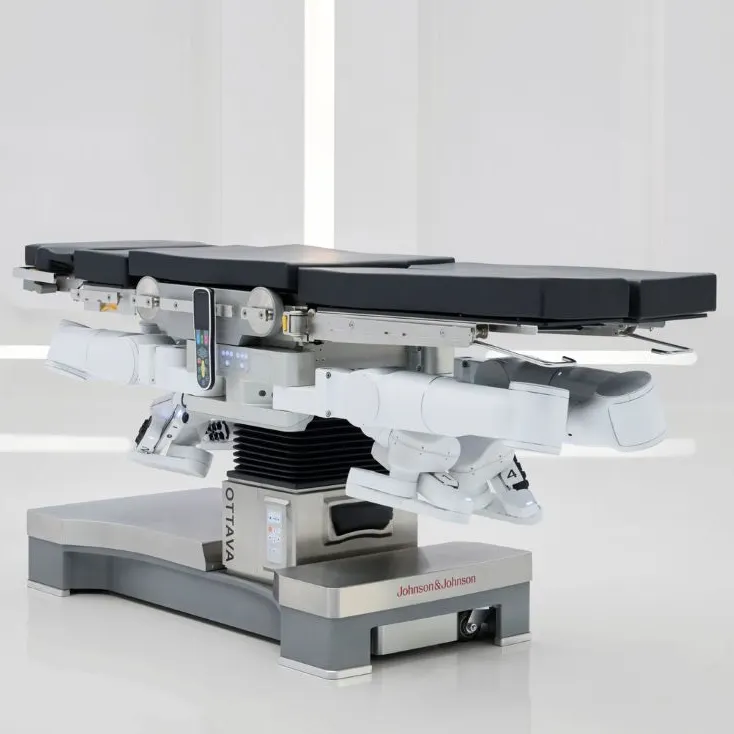
Ottava’s robotic arms are stowed under the surgical table when not in use.
Permission granted by Johnson & Johnson
This is 30% to 50% smaller than any other leading robotic system. It means it can fit pretty much in every operating room around the world. So we make every operating room a robotic operating room if needed, without having to refurbish the operating room, without having to expand the operating room. There are much better visibilities, and the workflows for the surgical team are much simpler.
What will the robot’s launch look like?
Our approach at the beginning is that we’re going to be working with leading institutions, very important institutions here in the U.S. that are experts in robotic surgery. Those institutions have been using robotic systems for many years and understand exactly what are the opportunities and potential limitations of existing robotic systems. We want to partner with them to really understand how we introduce, effectively, a new robotic system in their institutions, and deliver additional evidence to confirm and expand our value proposition.
From an architectural standpoint … this can fit in any site of care, in the U.S. and outside of the U.S.
Our first set of indications is in general surgery. But Ottava has to be a multi-specialty robotic system. So we’re going to do that aggressively in the next 12 to 18 months.
You’re going to see more clinical trials happening here in the U.S. You’re going to see a steady cadence of innovation coming onto Ottava with new instrumentation, new software capabilities, AI, automation coming onto the platform.
In parallel, we’re going to be expanding regulatory approvals outside of the U.S. because our ambition is to make Ottava a global program, not only a U.S.-based program.
The de novo approval is just our starting point.
How was surgeon feedback incorporated into the approach?
This is a robotic system that was designed by surgeons for surgeons. One of the things that we incorporated, for instance, is synchronized table motion. When surgeons are used to performing laparoscopy procedures, which has been the gold standard for many years in minimally invasive procedures, they use gravity by changing the position of the table and the patient on it during the procedure.
With the advent of robotic systems, that became much more complicated, and in some systems not possible, without having to interrupt, reset the system, and then continue the procedure, or without having to adopt a different table. We made this capability of using gravity during the procedure native into the system. This was based upon feedback by surgeons, for them to be able to go back to what they were used to, which is critical exposure of structures through gravity at any time of the procedure without interrupting the procedure.
How will J&J surgical instruments integrate with Ottava?
Surgeons have been using our instruments for many, many years. They trust them. They know they deliver. You can have a very good robotic system, but if you don’t have very good instruments that are really managing the tissue properly, that can be an issue, right? So we brought the instruments developed over many, many years onto Ottava and continued innovating on them.
Fifty percent of all hospital complications are related to surgery. If you think about leakages, if you think about infections or bleeding instances postoperatively, this is where the wealth of Johnson & Johnson Ethicon instrumentation comes into play.
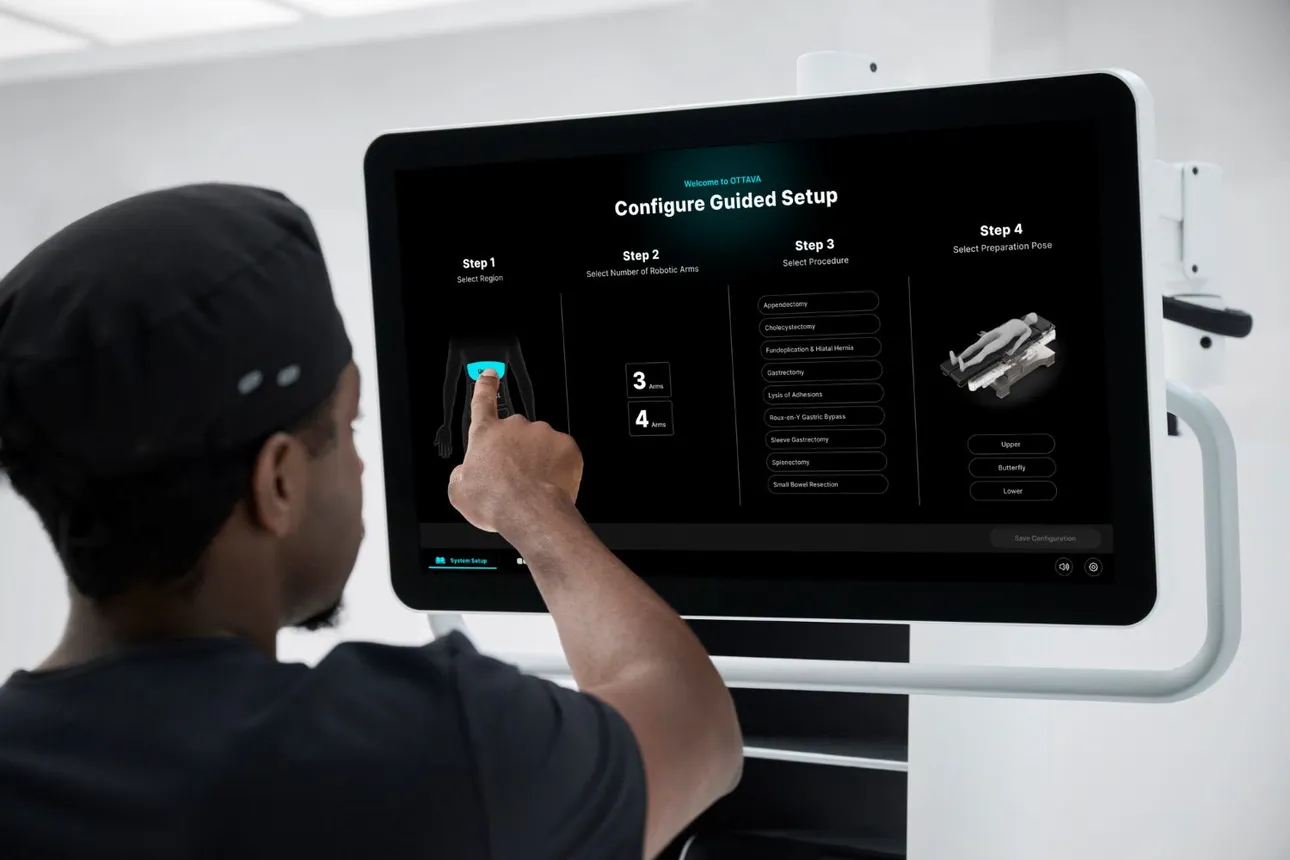
A clinician uses a touchscreen to set up the Ottava robotic system before a procedure.
Permission granted by Johnson & Johnson
On the economic side, how can Ottava help lower healthcare costs?
From a value standpoint, both economic and patient outcomes, clinical value is going to come from Ottava. Any operating room can be a robotic operating room. That’s very important for hospitals. We’re able to set up the system by a press of a button. The hospital staff doesn’t have to move booms, carts, register them, calibrate them around the operating table.
Everything comes automatically. Automation on a robotic system is extremely important, and it’s going to be a major capability that we’re bringing to market on day one.
One of the things we have done is develop automated procedure poses. For instance, if the surgeon knows that on that day, he or she has to perform a cholecystectomy or a Roux-en-Y gastric bypass or a prostatectomy, he or she can select on the screen the procedure that they’re going to perform, and by the press of a button, the robotic system is going to bring the surgical arms into a docking position for the procedure to start. When the arms go into that initial position, we optimize for the space between the arms for that specific procedure, so that there are no interruptions during that procedure.
There’s going to be very easy onboarding on the system because of that, and you can imagine in the future that more procedures will be able to be performed in a surgical OR where Ottava is, versus other robotic systems, because it’s going to be quicker and easier for the system to be set up.
