



Medtronic wants to improve the safety, quality and efficiency of surgery with an advanced computing platform for the operating room that boasts its first AI algorithm to receive Food and Drug Administration clearance.
“Today, surgeons likely have more AI assistance in the car when they drive home from a case than they have in the operating room whilst they operate, which, given what they’re doing in an operating room, may seem quite surprising,” said George Murgatroyd, Medtronic’s vice president and general manager of digital technologies. “We see a real gap there.”
The company is launching Touch Surgery Aide, a surgical computing platform that incorporates artificial intelligence during the procedure, fast enough to support decisions in real time. The technology runs multiple AI models simultaneously on the live procedure feed.
Medtronic recently showed off the platform at the Society of Robotic Surgery conference in Florida. MedTech Dive spoke with Murgatroyd to learn more about how the technology works and how Medtronic expects AI to assist surgeons as they perform procedures with its Hugo soft tissue robotic surgery system.
This interview has been edited for length and clarity.
MEDTECH DIVE: Medtronic is launching the next generation of its surgical computing platform. How does the technology help surgeons in their work?
GEORGE MURGATROYD: The Touch Surgery ecosystem has been deployed now in well over 1,500 operating rooms worldwide. We’ve solved, within that system, for a variety of things that we believe are setting a new standard of care, in terms of the assistance that surgeons should have, from immediate review of their cases, to automated benchmarking and analysis, to the ability to connect and collaborate during the case globally within a few taps.
Our next generation Touch Surgery brings one of the final jigsaw pieces in that digital transformation, which is enabling surgeons to receive real-time assistance whilst they operate.
IEP, our Instrument Exit Point, is the first algorithm that we have approval for — the first, we think, of many. That works on our Hugo robotic system and essentially tracks the instrument and notifies surgeons when they leave the field of view. It’s a bit like a blind spot in a car. Surgeons in that instance can no longer see the instrument. Our AI essentially provides a visual guide for where the instrument exited. It’s an important algorithm.
But one of the really exciting aspects of this is that we have opened the gate here to be able to bring to surgeons AI-powered assistance whilst they’re performing some of the most complex tasks on the planet, operating on patients in the moment.
We really do see a future where, in the background during cases, AI is running to support surgeons when they need it, and they don’t always know when they need it.
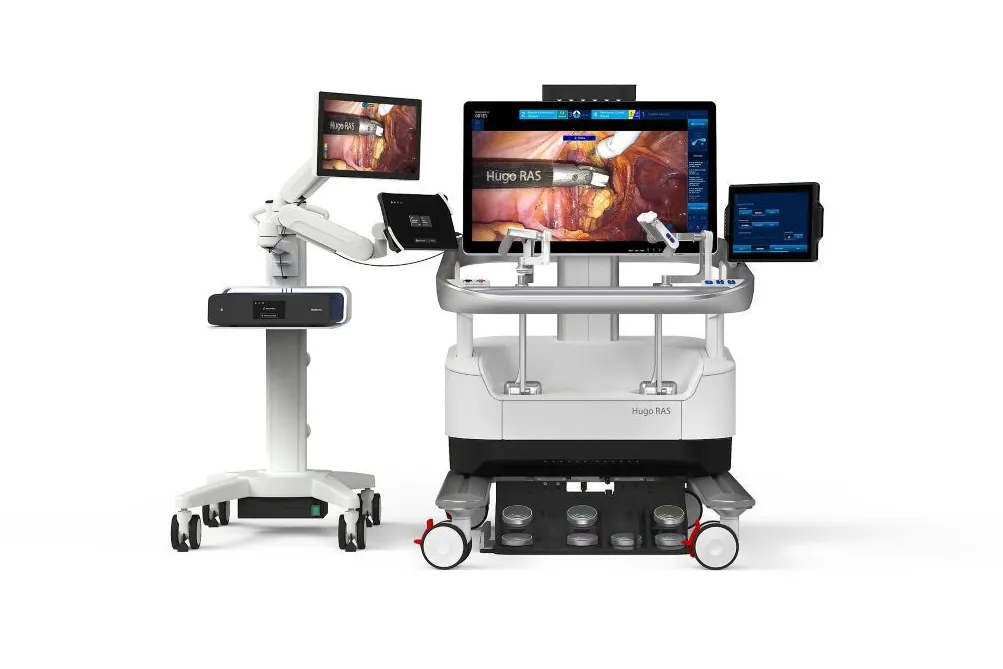
The console of Medtronic’s Hugo robotic system and the Touch Surgery Aide computing platform.
Courtesy of Medtronic
What are some examples of problems that your technology is solving for surgeons?
In order to provide AI to surgeons at the point of care, precisely the moment they are operating, you need computing, and you need computing power.
The vast majority of procedure rooms globally, including in the U.S. and across Western Europe, simply do not have that computing infrastructure to enable any AI to run. Some of the most expensive per-square-foot real estate in the world, with some of the highest paid individuals in the world and some of the longest trained, do not have infrastructure to support them in what we believe is going to be a really important transformative next stage.
So the Aide launch is twofold. The launch of Aide is solving that infrastructure problem. The second piece that we’re solving is that on that computer, we deploy AI that runs in real time, and IEP is our first algorithm.
Will the AI give advice?
It’s not an advisory algorithm, and we don’t make claims there. No, it’s to provide visual assistance. I think there will be a stepwise progression of this AI technology in the future, which is starting with the visual assistance. In time it would develop into real decision support, through to guidance, likely then through to potential semi-automation and automation. But we are at the very beginning of this journey.
Where does the data come from to build the algorithm?
Medtronic has a very robust data set. We benefited from the collaboration of hospitals worldwide and, really importantly, a representative data set of global surgery. It can focus on ensuring our data sets do not contain bias, that they are representative of the patients that surgeons treat, and clearly follow Medtronic’s AI ethics process and standards, which we set ourselves.
Why did you pursue an FDA clearance for the Instrument Exit Point application?
The FDA has approved quite a number of AI algorithms in medicine, but the vast majority of those are in radiology. That’s understandable because it’s often a still, black-and-white image. When you get to the extreme of surgery, where you’re working with video, you’re working with formable tissue that’s always moving, and then you’re designing AI to run during a procedure, I think we’re at the very complex end of AI in medicine.
Anything we present to surgeons visually, even if it’s providing visual assistance, is classified as a medical device. It’s on the screens as they operate, and we’re providing information to them that is important to them. So it has to follow a regulatory pathway because no patient would want surgeons to have unregulated, untested AI running whilst they’re being operated on.
What’s exciting for the industry is we are at quite an early stage of this development in surgery, too, and there is some really pioneering technology emerging. Aide, which is classified as a medical device data system, and our IEP algorithm are really part of the pioneering nature of some of this AI as a medical device within the surgical domain.
Is Touch Surgery Aide an open platform?
We fully expect to be hosting third-party applications on our Touch Surgery platform in the future.
There is a tremendous amount of innovation worldwide that is being worked on, whether it is in hospitals, small startups, very large medtechs like ourselves, all the way through to academic units. We do foresee a world where we can help catalyze and speed up the scale of that innovation to surgeons globally.
That’s really important because surgery is still variable. There is still unwarranted variation globally, and there are millions of surgeries performed worldwide. Being a digital leader and player within this space requires open thinking.
It’s important that companies like Medtronic provide that opportunity to bring, hopefully, life-changing innovation to the surgical domain.
