



What You Should Know
- The Data Source: Rock Health released its 11th Consumer Adoption of Digital Health Survey, polling 8,000 U.S. adults in December 2025 to track behaviors toward virtual care and digital health tools.
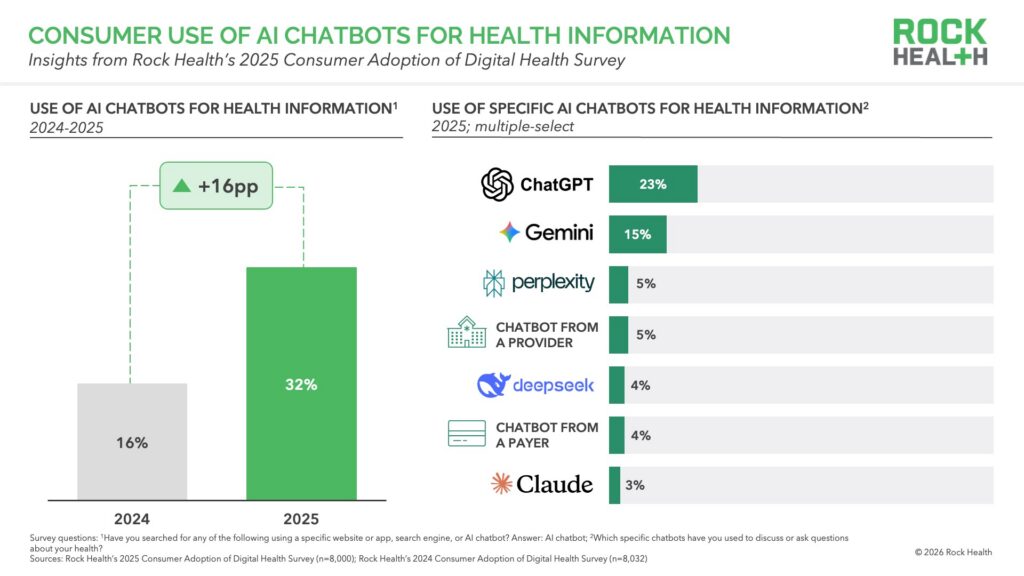
- The Adoption Spike: Consumer use of AI in healthcare is exploding. 32% of respondents report having used an AI chatbot for health information—double the share from just a year ago (16%). Of those users, 64% engage with health AI weekly or more.
- General Purpose vs. Healthcare Built: Consumers aren’t waiting for hospitals to build custom bots. Nearly three-quarters (74%) of AI users turned to general-purpose tools like ChatGPT, compared to just 5% using provider-offered bots and 4% using payer-offered bots.
- The AI “Superuser”: The typical AI user is a highly proactive “healthcare superuser.” They track an average of four health metrics (spiking in lifestyle indicators like sleep and stress) and report higher healthcare utilization across both virtual and in-person modalities than non-users.
- The Democratization of Access: Unlike previous digital health waves (like wearables or telehealth) where adoption was heavily dictated by wealth, the survey found no meaningful differences in AI adoption across income or education levels.
- Taking Action: AI isn’t replacing the doctor; it’s accelerating the journey. 81% of AI users report taking an action after an AI query, such as searching for more information, trying a new health behavior, or directly consulting a provider.
Why Patients Are Adopting AI Faster Than Their Doctors
According to the newly released Consumer Adoption of Digital Health Survey from Rock Health, one in three U.S. adults (32%) now use AI chatbots to navigate their health—a staggering 100% year-over-year increase. More importantly, they aren’t using the clunky, highly regulated chatbots embedded in their hospital’s patient portal. They are overwhelmingly firing up ChatGPT to bypass the system entirely.
“The healthcare status quo isn’t working,” noted Dr. Robert Wachter, Chair of the UCSF Department of Medicine, in the report. “I can’t see how we get to better, safer, more accessible, more convenient… care unless we use AI tools effectively.”
The Profile of the AI ‘Superuser’
The most fascinating revelation in the Rock Health data is who is using this technology.
Historically, the first wave of any digital health innovation—like continuous glucose monitors or premium telehealth subscriptions—is adopted by the wealthy. But because general-purpose LLMs are largely free and ubiquitous, Rock Health found no meaningful differences in AI adoption across income or education brackets.
Instead, the defining characteristic of the AI user is behavior. They are healthcare “superusers.” They actively track modifiable lifestyle indicators like sleep (43%), diet (40%), and stress (35%) at significantly higher rates than non-users. They are using AI to synthesize their personal health data stack, searching for diagnoses, exploring treatment options, and decoding prescription side effects.
Crucially, this AI usage isn’t keeping them out of the doctor’s office. In fact, AI users report higher healthcare utilization across the board. They are showing up to clinical encounters heavily researched, hyper-informed, and highly specific in their expectations.
The Privacy Trade-Off
This sprint toward consumer AI does come with a massive blind spot: data privacy. While AI users still fundamentally trust their clinicians, they are casting a much wider net. They are significantly more willing to share their sensitive health data with consumer tech and health tech companies than non-users.
“The second we leave the walls of the healthcare system, we’re trading off for a lot of other risks and lack of rights,” warned Andrea Downing, Co-founder of The Light Collective. Outside of HIPAA’s jurisdiction, there is no duty of confidentiality and very little accountability when an LLM hallucinates a triage recommendation.
Other key findings of the survey include:
Adoption by Generation There is a stark generational divide in who is utilizing health AI:
- Millennials: 48%
- Gen Z: 45%
- Gen X: 25%
- Baby Boomers: 12%
- Silent Generation: 7%
Adoption by Gender, Income, and Education
- Gender: Men reported a slightly higher adoption rate (34%) compared to women (30%).
- Socioeconomic Status: The survey found no meaningful differences in AI adoption across income or education brackets. This differs from earlier digital health innovations (like wearables or telehealth), which were initially heavily dictated by affordability.
Behavioral Differences: AI Users vs. Non-AI Users
The data shows that AI users are “healthcare superusers” who approach their health data differently than non-users:
- Health Tracking: AI users track an average of 4 health metrics, while non-users track an average of 3. AI users are significantly more likely to track lifestyle indicators such as sleep (43% vs. 28%), physical activity (41% vs. 32%), diet (40% vs. 28%), and stress (35% vs. 22%).
- Trust in Information: AI users are much more willing to trust non-traditional digital sources, including health apps (55% vs. 25%), AI chatbots (56% vs. 15%), and social media (36% vs. 11%). Both groups still maintain high trust in clinicians (85% for AI users vs. 88% for non-users).
- Data Sharing: AI users are less likely than non-users to share their health data with traditional healthcare providers (56% vs. 71%). However, they are roughly twice as likely to share their data with health tech companies (23% vs. 11%) and consumer tech companies (15% vs. 4%).
The 11th Consumer Adoption of Digital Health Survey available here for more insights.
