



For many of us, long hours at a desk are simply part of modern life, but our posture is quietly paying the price. Long bouts of sitting, whether during office work or gaming, can lead to rounded shoulders, tight hip flexors and an overworked lower back, while the muscles that stabilize your spine gradually lose strength.
These imbalances don’t just affect how you sit – they can also influence how you walk, exercise and recover after workouts. But the good news is, targeted yoga moves can help.
Anouska Shenn is a qualified yoga instructor and she specialises in delivering ‘desk yoga’ to office workers.
“When we sit at a desk for long hours, the muscles in our back get weaker from being placed in a passive stretch, conditioning us for more of the same,” she says. “If we want to break the cycle, we need to move more throughout the day and return our spine to its natural alignment more often.”
Moving more throughout the day can be done with the help of our best under-desk treadmills or best standing desk lists, as well as movement alerts from smartwatches. However, you can also improve posture and undo sedentary damage through stretching, which doesn’t have to be done on a yoga mat – it can also be done right at your desk.
Try adding the following beginner-friendly yoga exercises to your day – they’ll help release stiffness and correct unwanted muscular imbalances. Shenn, the founder of The Office Yoga Company, has made things even easier by selecting moves that can be done at your desk from a seated position.
1. Seated Cat-Cow
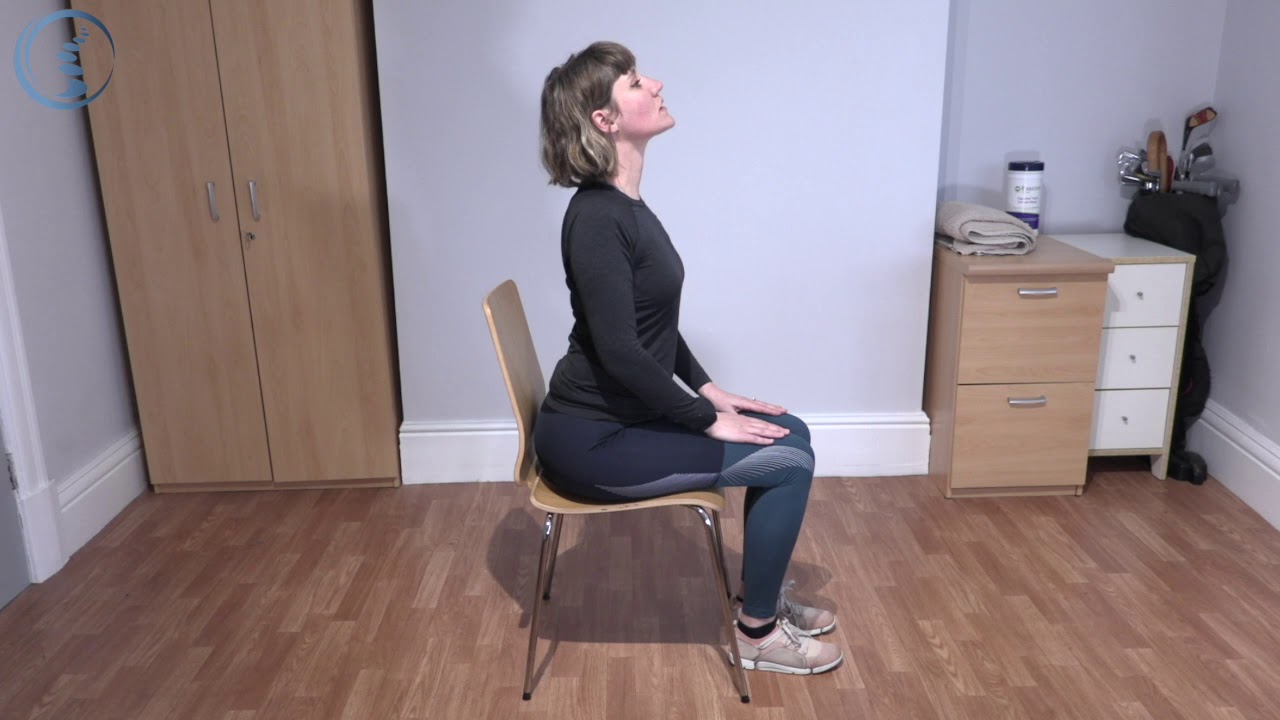
Cat-cow is a common yoga warm-up move, and one of the simplest ways to reset your posture. It’s a gentle, flowing movement that takes your spine through flexion and extension, helping to ease tension in the shoulders while improving overall mobility. Because it’s a dynamic movement rather than a static stretch, it also helps you rebuild control over how your spine moves – something that can easily get lost when we stay seated for too long.
Shenn recommends focusing on the breath as you move, particularly the exhale.
“Really drawing the lower abdominals in and up on the exhale helps you stretch into the lower back,” she says. Over time, this awareness can help you sit taller and avoid falling back into a rounded posture.
How to do it:
- Sit towards the front of the chair.
- Place your hands on your hips.
- Inhale, as you tip the pelvis forwards – bringing your front hip bones down towards the legs – and arch your spine. Tip your head back if that feels good for your neck.
- Exhale, draw your abdominals in and up, curl your tailbone under, and round your back, nodding your chin to your chest.
- Continue alternating between positions as you breathe slowly, for 5–8 breaths.
- Once you get a feel for the tilting of the pelvis, try this with your hands placed on your knees.
2. Seated Backbend
Long stretches of keyboard work tend to pull the shoulders forward and weaken the muscles that support the upper spine. The seated backbend is designed to reverse that pattern by opening the chest and encouraging activation through the mid- and upper-back – two areas that play a huge role in posture.
Shenn notes that the hand clasp behind the back adds an extra stretch for the chest and the fronts of the shoulders.
“Make sure you are breathing smoothly and easily throughout the pose,” she adds. “If you find that you’re breathing shallowly or holding your breath, back off the stretch or take a rest.”
How to do it
- Sit towards the front third of the chair.
- Interlace your hands behind your back, palms facing each other.
- Take a deep breath in; exhale, as you press your knuckles down into the chair and lift up through the centre of your chest.
- If it feels okay for your neck, you can gently tip the head back.
- Hold for 3–5 breaths and then return to an upright position.
3. Seated spinal twist
Twisting movements are often overlooked when we think about posture, but they’re essential for keeping the spine mobile – especially through the thoracic (mid-back) region, which can stiffen when we sit for long periods. The seated twist is a great way to finish a short desk-yoga sequence, as it will help bring the spine back to neutral after movements like rounding and arching.
Shenn describes this pose as a perfect ‘movement snack’ during the workday because it wakes up the core without feeling strenuous. Rather than pulling yourself deeper with the arms, she advises initiating the rotation from your centre, allowing the spine to move in a controlled and supported way. Done regularly, it can help counteract stiffness and make everyday movements feel smoother.
How to do it
- Sit tall, feet planted firmly.
- Inhale to lengthen the spine, exhale to rotate from the waist, looking over the right shoulder.
- Place the left hand on the outside of the right knee, reaching your right arm back.
- Drive the twist from your core muscles, not by pulling with the arms.
- You can hold onto your backrest with your right arm for a less active variation of the pose.
- Hold 3–5 breaths, then repeat on the other side.
