

Close Menu

    Subscribe to Updates

    Get the latest creative news from Healthradar about News,Health and Gadgets.

    Bitte aktiviere JavaScript in deinem Browser, um dieses Formular fertigzustellen.
    Wird geladen
    What's Hot

    Marvel-ous: After 7 years, Chris Hemsworth’s Centr app has quietly transformed into one of the best fitness platforms on mobile

    5. Februar 2026

    Fitbit Co-Founders James Park and Eric Friedman Launch Luffu, an AI Family Care System

    5. Februar 2026

    FTC Secures Landmark Settlement with Express Scripts to Lower Drug Costs for American Patients

    5. Februar 2026
    Facebook X (Twitter) Instagram
    Facebook X (Twitter) Instagram Pinterest Vimeo
    healthradar.nethealthradar.net
    • Home
    • Ai
    • Gadgets
    • Health
    • News
    • Contact Us
    Contact
    healthradar.nethealthradar.net
    Home»Ai»How human motion is fueling the robot revolution — by teaching robots like Atlas to move in lifelike ways
    Ai

    How human motion is fueling the robot revolution — by teaching robots like Atlas to move in lifelike ways

    HealthradarBy Healthradar15. Januar 2026Keine Kommentare5 Mins Read
    Share Facebook Twitter Pinterest LinkedIn Tumblr Reddit Telegram Email
    How human motion is fueling the robot revolution — by teaching robots like Atlas to move in lifelike ways
    Share
    Facebook Twitter LinkedIn Pinterest Email


    As TechRadar’s Senior Health and Fitness Editor, I’ve used a lot of movement-tracking tools, from the best smartwatches to gait analysis and even AI tools to calculate movement efficiency.

    I’ve also spoken to people responsible for making some of the best running shoes on the planet, who have made it their lives‘ missions to understand the complex biomechanics of the human foot and body – how the foot splays as it falls, how the position of the knee affects the efficiency of the stride, what kind of adjustments to make to the shoes to mitigate issues, and so on.
    What I’ve learned from all this is that the human body is a sophisticated mechanical object, constantly making micro-adjustments we aren’t even aware of even during simple walking movements.


    You may like

    So, when I sat down at my desk to cover the first day of CES 2026, and heard about the latest humanoid robots folding laundry, playing chess and walking around, I was expecting a bunch of awkward-looking, pincer-armed machines with black screens in lieu of faces. I’d seen the early Boston Dynamics videos of those clumsy robots being stress-tested (read: bullied), and expected more of the same.

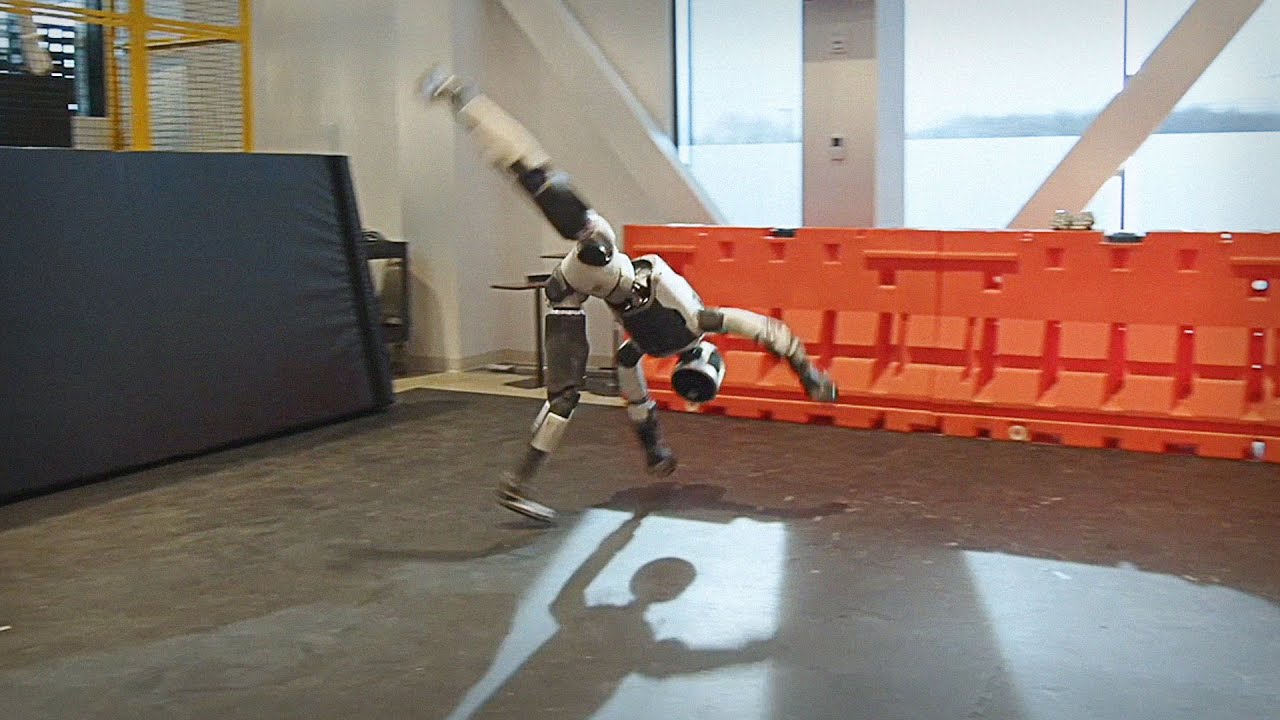
    You can imagine my surprise, then, when I watched a video of the goings-on at CES and for the first time, understood how lifelike humanoid robots were becoming. I saw Boston Dynamics‘ Atlas robot begin to break into a run, then slow itself down to a halt. It lifted its leg and placed itself in a martial-arts-like stance, spinning its claws (terrifying) while gesturing to an inert robot to its left. It squatted down to pick up an imaginary object in a way that looked very natural, despite twisting its ball-socket legs and torso in ways that would impossible for a human to replicate.

    Walk, Run, Crawl, RL Fun | Boston Dynamics | Atlas – YouTube
    Walk, Run, Crawl, RL Fun | Boston Dynamics | Atlas - YouTube


    Watch On

    I was fascinated. As someone who looks at the intersection of human performance and technology on a regular basis, that little run felt like a landmark moment. The Atlas‘ walking demonstration at CES, which you can see below in a video taken by our own Editor-at-Large Lance Ulanoff at his Atlas experience, still looked a little gawkish; like a shuffling, half-squat walk with small steps in case it fell over, rather than a confident stride.

    However, watching the majority of the demonstration both thrilled and unnerved me. Atlas was so lifelike while it was moving, and yet the moment the robot came to a halt I was left cold by how unnaturally still it became. The contrast between this statue-like assemblage of metal and plastic and a living, breathing person was jarring.

    How on earth did Boston Dynamics get its Atlas robot to copy a movement in this degree of detail?

    Sign up for breaking news, reviews, opinion, top tech deals, and more.

    Motion capture and VR

    The CBS news show 60 Minutes aired a segment – you can see the video below – on Boston Dynamics and Atlas, which featured a visit to the Hyundai factory in which the robot is being tested, and included a look at the way new movements are taught to the robot.

    My use of ‚taught‘ rather than ‚programmed‘ is deliberate: the development team uses AI and repetition to encourage the robot to learn a movement, rather than follow a pattern precisely. The reason for this is that the robot’s body is very different to a human body, despite its similar size and proportions, and must find the most efficient pathway on its own. Boston Dynamics dubs this method ‚kinematics‘.

    I’ve embedded the video below, but the long as the short of it is that Boston Dynamics records patterns of human motion by getting a human model to perform the movement. They’re wearing either an Xsens motion-tracking bodysuit for full-body movements, or a virtual-reality headset and handsets for more dexterity-based tasks, such as tying a knot.


    You may like

    This turns physical motion into digital data, which can be ‚retargeted‘ or mapped from a human body onto a robot body to account for the different proportions and joints of the robot.
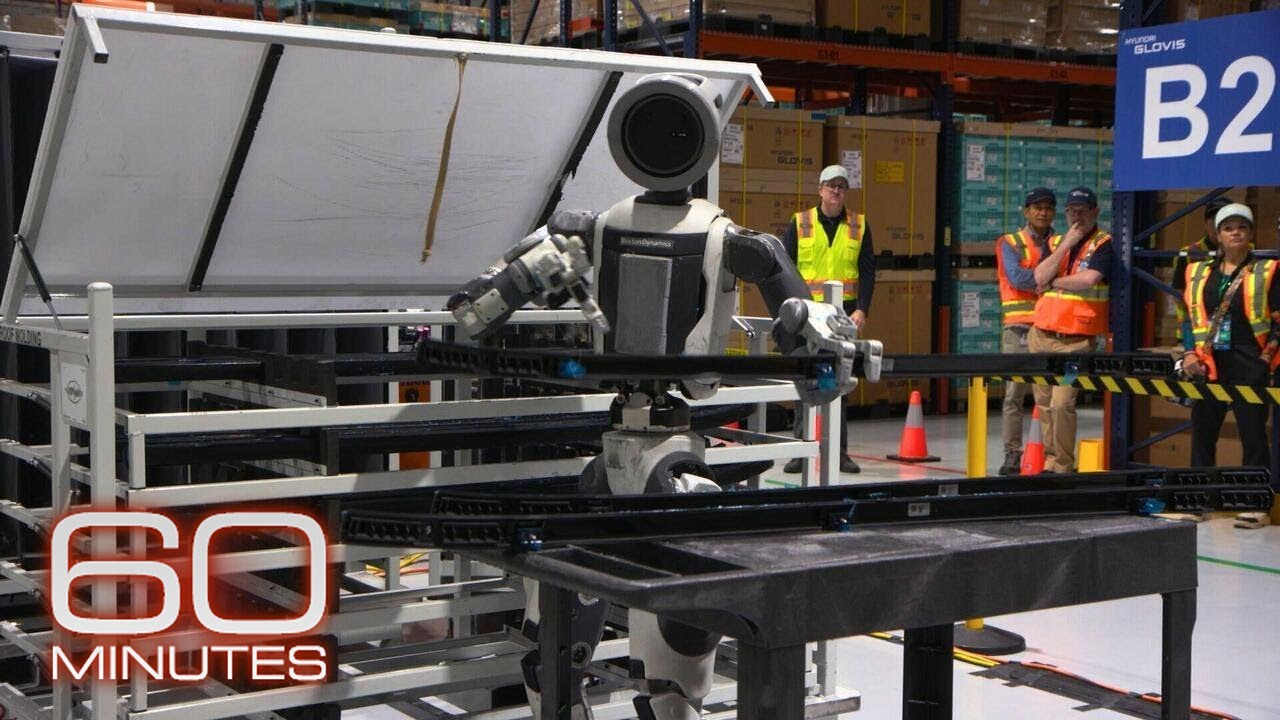
    Progress made on AI-powered humanoid robots | 60 Minutes – YouTube
    Progress made on AI-powered humanoid robots | 60 Minutes - YouTube


    Watch On

    Once that’s done, the robot learns how to perform the movement in a simulation environment. In the 60 Minutes video you can see thousands of virtual robots performing a basic jumping jack. Some of them fall, stumble or perform the move incorrectly, but many of them get it right. Each simulated movement creates more data.

    Once the robot’s collective hive mind (also terrifying) has figured out the best way of doing the movement, this data is rolled out to a whole fleet of robots, so the robotics team can train new movements at scale with massive efficiency. In this way, a whole army of robots can be trained to perform a new movement pattern in an afternoon, such as operating a new production line – but hopefully not more complex patterns, such as moving in sync to rise up against their former masters.

    Xsens, in a blog post, describes this pipeline in far simpler terms: „Capture human motion → Retarget to the robot → Train at scale in simulation → Deploy to hardware → Repeat.“

    Despite the fact that robots can move in unnatural ways, they aren’t yet anywhere close to moving as efficiently as humans can, or with as much complexity. However, they’re certainly getting there, and it looks like we’re only a few short years from seeing genuinely humanoid robots in the home, the workplace and all sorts of other arenas.


    Follow TechRadar on Google News and add us as a preferred source to get our expert news, reviews, and opinion in your feeds. Make sure to click the Follow button!

    And of course you can also follow TechRadar on TikTok for news, reviews, unboxings in video form, and get regular updates from us on WhatsApp too.


    Source link

    Atlas Fueling Human Lifelike motion Move revolution Robot robots teaching Ways
    Share. Facebook Twitter Pinterest LinkedIn Tumblr Email
    Previous ArticleTrump administration rolls back $2 billion mental health, addiction grant cuts
    Next Article Boston Scientific to acquire Penumbra for $14.5B
    ekass777x
    Healthradar
    • Website

    Related Posts

    Ai

    Marvel-ous: After 7 years, Chris Hemsworth’s Centr app has quietly transformed into one of the best fitness platforms on mobile

    5. Februar 2026
    Ai

    “We’re building something I want for my family and your family”: Fitbit co-founders are launching a new family-wide health tracker, but we have our reservations

    4. Februar 2026
    Ai

    Keen cyclist? Take our survey for a chance to win a $300 / £250 Amazon voucher

    3. Februar 2026
    Add A Comment
    Leave A Reply Cancel Reply

    Top Posts

    Garmin Venu 4: Everything we know so far about the premium smartwatch

    7. August 202586 Views

    Nanoleaf LED face mask review: fantastic value for money, but only by cutting some corners

    16. Oktober 202550 Views

    The Top 3 Tax Mistakes High-Earning Physicians Make

    7. August 202535 Views

    Dexcom raises sales expectations, discusses G8 plans

    31. Juli 202523 Views
    Stay In Touch
    • Facebook
    • YouTube
    • TikTok
    • WhatsApp
    • Twitter
    • Instagram
    Latest Reviews

    Subscribe to Updates

    Bitte aktiviere JavaScript in deinem Browser, um dieses Formular fertigzustellen.
    Wird geladen
    About Us

    Welcome to HealthRadar.net — your trusted destination for discovering the latest innovations in digital health. We are dedicated to connecting individuals, healthcare professionals, and organizations with cutting-edge tools, applications

    Most Popular

    Garmin Venu 4: Everything we know so far about the premium smartwatch

    7. August 202586 Views

    Nanoleaf LED face mask review: fantastic value for money, but only by cutting some corners

    16. Oktober 202550 Views
    USEFULL LINK
    • About Us
    • Contact Us
    • Disclaimer
    • Privacy Policy
    QUICK LINKS
    • Ai
    • Gadgets
    • Health
    • News
    • About Us
    • Contact Us
    • Disclaimer
    • Privacy Policy
    Copyright© 2025 Healthradar All Rights Reserved.

    Type above and press Enter to search. Press Esc to cancel.