



What You Should Know:
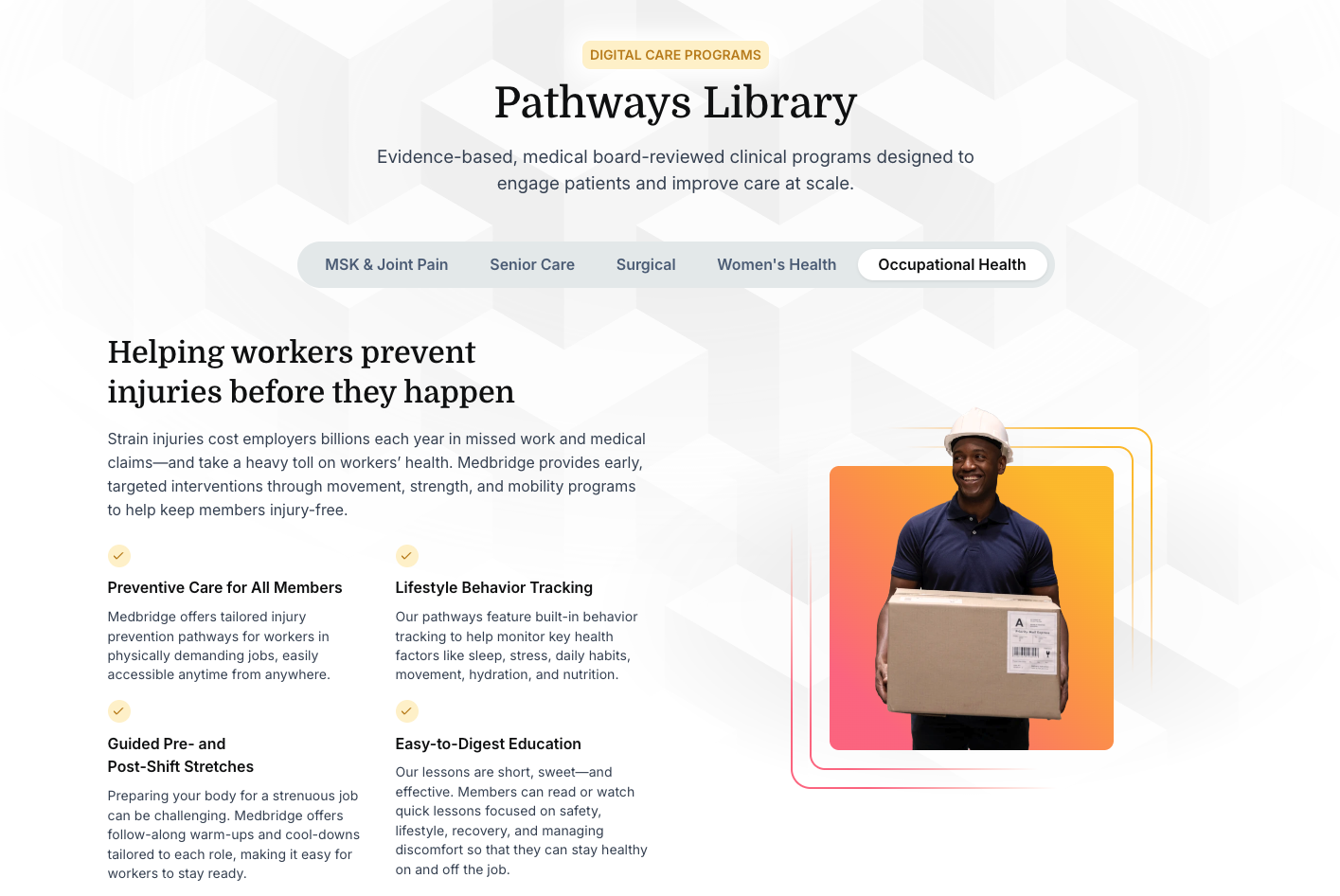
- The Launch: Digital care leader Medbridge has introduced a new Occupational Health Pathway, available within its Medbridge One Care platform.
- The Market Problem: Musculoskeletal (MSK) disorders stemming from repetitive motion injuries account for approximately 28% of all serious work injuries. Strikingly, 35% of these injuries occur within an employee’s first year on the job.The Shift to Proactive Care: Traditional workforce health solutions are often strictly on-site and entirely reactive—applied only after a worker is injured. Medbridge is deploying a hybrid (live or virtual) model focused on early intervention and injury prevention.
- The Target Audiences: The platform initially offers three specific tracks tailored to the unique physical demands of high-risk “industrial athletes”: production/material handlers, mechanical/facility maintenance workers, and driver/equipment operators.
- The Clinical ROI: According to internal data, the platform drives rapid engagement (43% of patients log in within the first two hours) and tangible clinical results, with 70% of patients reporting a reduction in pain within 30 days.
Decentralizing Occupational Health
Historically, occupational health has been heavily localized. If a factory worker strained their shoulder, they would visit the on-site clinic—if the facility even had one—after the damage was done. As a result, repetitive motion injuries account for roughly 28% of all serious workplace injuries, with a staggering 35% of those occurring in an employee’s very first year on the job.
Medbridge is breaking that physical constraint. By embedding its new Occupational Health Pathway into the broader Medbridge One Care platform, the company is enabling advanced primary care clinics, health systems, and private practices to deploy preventative hybrid care (live and virtual) directly to the worker, wherever they are.
“Industrial workers face unique health risks that standard wellness programs simply don’t address: repetitive stress, shift work challenges, and physically demanding roles that take a real toll,” said Krystol Hines, a physical therapist and ergonomics expert who uses Medbridge to support workers and serves on Medbridge’s clinical advisory board. “The goal is simple: equip workers with knowledge to protect themselves from injury, make better health choices early, and maintain quality of life so work enhances rather than limits what they can do beyond the job.”
To ensure the clinical content actually resonates with the workforce, Medbridge is initially launching three highly targeted tracks tailored to the specific biomechanical demands of different roles:
- Production and Material Handlers
- Mechanical and Facility Maintenance Workers
- Driver and Equipment Operators
The Engagement Engine
In digital health, the best clinical pathway in the world is useless if the patient never logs in. Medbridge’s historical engagement metrics suggest they have cracked the code on adoption.
According to the company’s internal data, 43% of patients assigned to a Medbridge digital care program log in within the first two hours, and 58% engage within the first two days. More importantly, this engagement translates to clinical efficacy: 70% of patients report a reduction in pain within 30 days, driving an 86% overall satisfaction rate.
“Millions of workers are injured on the job every year, affecting their ability to work and enjoy their lives,” said Donovan Campbell, CEO of Medbridge. “By delivering more engaging, clinically effective, and accessible preventive care, we are addressing the needs of the modern industrial athlete. This not only supports the quality of life for individuals, but also translates directly into measurable outcomes: reduced claims, lower costs, and a healthier, more engaged workforce.”
