



One year after President Donald Trump’s “Liberation Day” declaration in a White House Rose Garden ceremony unleashed a tariff policy targeting top U.S. trading partners, medtech companies are still absorbing the shocks.
Tariffs on imports from China, Mexico, Canada, the European Union and other key trade partners were meant to boost domestic manufacturing, but in the medtech sector, where integrated global supply chains designed for efficiency can take years to establish, reshoring has not been the primary response. That’s in contrast to the pharmaceutical industry and certain other sectors, where companies are pouring billions of dollars into building new production facilities in the U.S.
To manage the extra expenses brought by tariffs, medtech companies have tried to avoid raising prices for hospitals and health systems or cutting R&D budgets, according to industry advisers and analysts. Instead, they are accelerating efforts to drive down costs across their organizations.
“They have to find levers elsewhere,” said Glenn Hunzinger, PwC’s U.S. health industries leader. “They’re not passing the prices on to customers. They’re just bearing the brunt of it and trying to find efficiency, which was always the focus.”
PwC found medtech companies stand to receive as much as $2.6 billion in refunds for duties collected under the International Emergency Economic Powers Act, according to U.S. Customs and Border Protection data, after the Supreme Court ruled in February that the president lacked authority under the statute to impose tariffs.
For some of the largest individual medtech companies, the impact from tariffs on earnings is upwards of $200 million to $500 million on an annual basis, Hunzinger noted.
“The dollars are significant,” he said. “It’s having an impact on the bottom line and ultimately on share value.”
As tariff pressures on medical device makers have evolved from the initial upheaval into a standing operational constraint, identifying more ways to reduce spending will remain a priority, to keep the costs from flowing to the bottom line. Most companies, Hunzinger said, have gone through some level of reductions.
“Every medtech company knows that they need to continue to transform, to get more efficient, to be able to make products more affordable in order to continue to have money to innovate,” Hunzinger said.
New tariffs, same outcome
To replace the IEEPA levies, Trump quickly turned to Section 122 of the Trade Act of 1974 to impose a broad 10% tariff on imports. Under Section 122, a president can institute tariffs of as much as 15% for up to 150 days to address trade imbalances. In addition, the U.S. has launched new investigations targeting numerous trading partners under Section 301 of the same act that could lead to more sustained duties if their practices are found to unfairly restrict U.S. commerce.
The administration’s swift action substituting Section 122 tariffs for IEEPA tariffs underscores that the levies are a central pillar of the government’s economic policy, analysts said.
“The Trump administration is going to find one way or another to implement tariffs,” said RBC Capital Markets analyst Shagun Singh.
Despite the changing tariff mechanisms, the cost to device makers has stayed similar. “It’s kind of a wash, as far as what I’ve heard from most of the companies,” said Needham analyst Mike Matson.
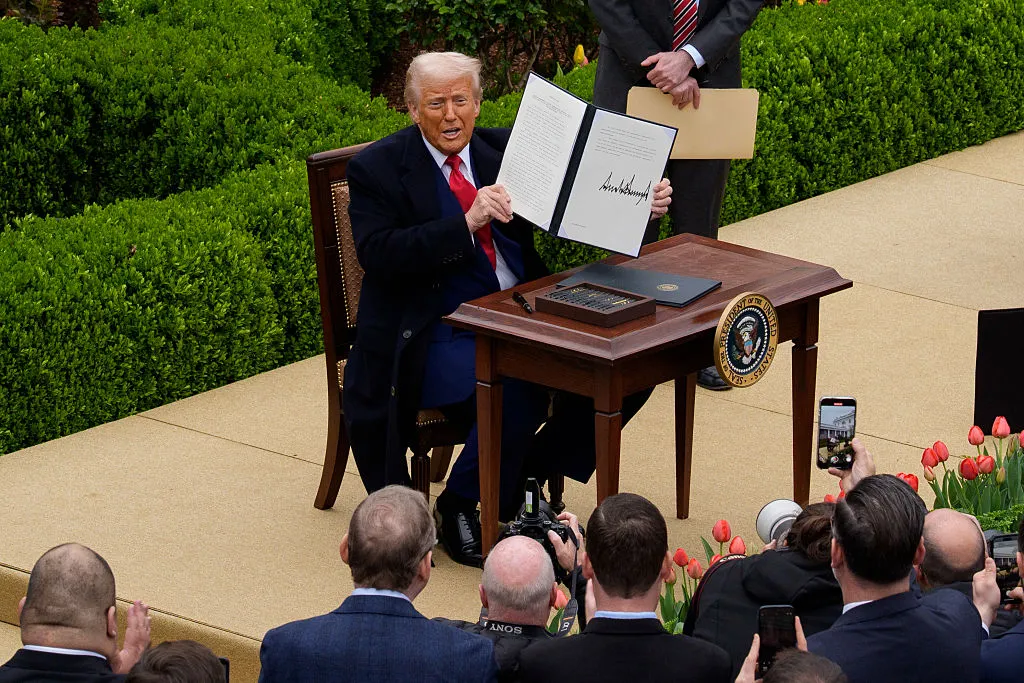
President Donald Trump holds his executive order imposing tariffs during the “Liberation Day” event in the White House Rose Garden on April 2, 2025.
Andrew Harnik via Getty Images
The medtech sector is also the subject of a Section 232 probe to determine if imports of medical devices, ranging from personal protective equipment to medical consumables and equipment, threaten national security. The investigation has hung over the industry since September. Yet Singh does not expect Section 232 to become a tool for applying more tariffs to device imports.
“Generally, medical devices is not a sector that the Trump administration is looking at negatively and wants to single out and increase tariffs on,” said Singh. “If anything, it’s the opposite.”
Medtech industry group AdvaMed has pushed for a tailored approach to tariffs to ensure that companies can maintain trusted supply networks, arguing some policies could create unintended risks for healthcare providers and patients.
Tariffs dented gross margins for many medtech companies in 2025 and will do so again this year. However, the headwind has been manageable, without widespread layoffs or deep cuts to R&D budgets, analysts said. For device makers, said Singh, the hospital environment and procedure volumes will remain the most important determinants of revenue growth.
“R&D is absolutely the last thing our companies want to cut,” said Singh. “Our companies are still managing businesses for the long term.”
Likewise, Matson characterized the impact to medtech companies as modest and not a driving factor for job losses in the sector. “Most companies still grew their earnings last year despite the tariffs,” he said.
Mitigating the impact
Medtech organizations are taking proactive steps to navigate the new tariff environment, said Christopher Young, principal in the trade and customs practice at KPMG US. Companies are using tariff modeling tools to find savings strategies, reassessing materials, optimizing logistics and securing alternative suppliers where possible.
“Life sciences leaders now treat variables like tariffs, interest rates and political uncertainty as expected operating conditions – factors to be managed within their strategic playbooks rather than forces that dictate abrupt shifts in decision-making,” Young said in an email.
Identifying tariff exemptions, such as for prototypes or devices to address chronic or permanent conditions, are among the mitigation strategies, he said. Companies are also revisiting design choices and evaluating where regulatory considerations allow for supplier shifts.
“We’re seeing targeted shifts, not sweeping relocations,” Young said.
For simpler, lower-cost products, companies have moved sourcing among lower-tariff regions. For complex medical devices that rely on specialized components, precision materials and electronics, qualified suppliers are not easily swapped without regulatory consequence.
“R&D is absolutely the last thing our companies want to cut. Our companies are still managing businesses for the long term.”

Shagun Singh
RBC Capital Markets analyst
In some cases, companies are spreading manufacturing across multiple geographies and building secondary supplier relationships. Some domestic manufacturing has expanded, Young said, particularly where deeper technical collaboration or regulatory familiarity provides an advantage, but not at a scale that replaces established global networks.
“Where the costs cannot be offset, many companies have absorbed a portion of the added cost to protect market access and customer relationships, especially for products critical to patient care,” said Young.
All eyes on Section 232
Young advises companies in the sector to closely watch the Section 232 investigation on medical products, as well as the Section 301 investigations, because these are generally on surer legal footing. Medtech’s reliance on imported precision materials and components means even narrow changes can have outsized effects, he said.
Arun Venkataraman, partner at the Covington law firm, said that because medical devices are covered separately in the Section 232 investigation, the administration would therefore have to decide whether to exclude them from Section 301 reviews.
The Section 232 probe into the pharma industry, concluded last week, exempts a set of companies that have committed to manufacturing more in the U.S. and signed most-favored-nation pricing deals. Venkataraman said it is possible the administration may similarly be open to negotiating deals that grant tariff relief to medtech companies that commit to investing in the U.S.
Medtech companies that import products such as chemicals and other reagents should look at whether they are affected by the pharma Section 232 decision, Venkataraman added. Other tariff actions that have implications for the medtech industry include new rules on steel and aluminum, which were adjusted last week, and country-specific agreements. The U.S.-China trade truce and EU trade deal are two that merit close attention, he said. The United States-Mexico-Canada Agreement is also under review.
“You have this mosaic of tariffs that medical device manufacturers have to navigate,” said Venkataraman.
