



What You Should Know
- Venture fund and digital health advisory firm Rock Health published its Q3 2026 Market Update in October 2026, titled Q3 2026 Market Update: Crystallizing Fifteen Years of Digital Health, commemorating the 15th annual Rock Health Summit and reflecting on the sector’s evolution since 2011.
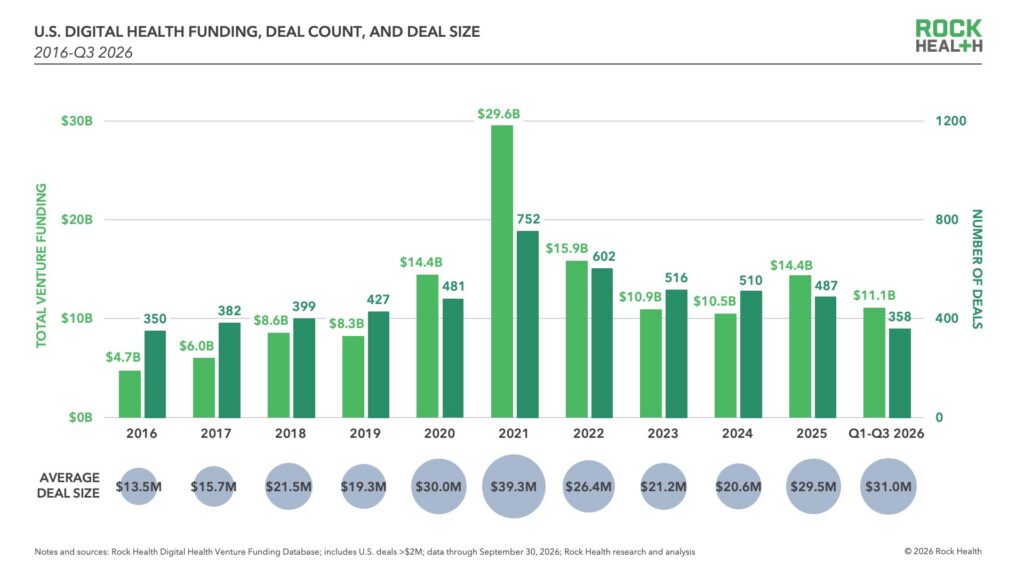
- U.S.-based digital health startups raised $3.7B across 114 deals in Q3 2026, bringing 2026’s year-to-date (YTD) total to $11.1B across 358 deals (projected to surpass $14.8 billion by year-end).
- Capital continues to consolidate into larger checks across fewer companies: the 2026 YTD average deal size climbed to $31.0M, up from $29.5M in 2025 and $20.6M in 2024.
Rock Health’s 15-Year Market Review Analyzes $140B in Capital and Q3 2026’s Flight to Deployable Value
Marking its 15th anniversary and the 15th annual Rock Health Summit, digital health venture fund and advisory firm Rock Health released its Q3 2026 Market Update: Crystallizing Fifteen Years of Digital Health. The report pairs venture funding, M&A, and public-market tracking with a 15-year retrospective featuring founding pioneers, venture capitalists, and health system executives.
The central takeaway reflects a maturing, disciplined asset class: while total venture funding has normalized from pandemic peaks into sustained annual totals exceeding $10 billion, capital is consolidating into larger checks and fewer companies. Concurrently, enterprise buyers have abandoned point-solution experimentation in favor of architectural consolidation, shifting competition from speculative software builds toward proven implementation and deployable value.
Q3 2026 & Year-to-Date Venture Capital Benchmarks
Digital health financing across the first nine months of 2026 demonstrates consistent capital concentration:
- Quarterly Capital Inflow: U.S.-based digital health startups secured $3.7B across 114 funding rounds in Q3 2026.
- Year-to-Date Volume: YTD 2026 funding reached $11.1B across 358 deals, tracking toward an annualized projection of $14.8B (roughly 12 times the total invested in 2011).
- Expanding Average Check Size: Capital is concentrating into fewer, higher-conviction bets, with the 2026 YTD average deal size expanding to $31.0M, up from $29.5M in 2025 and $20.6M in 2024.
- Steady Strategic M&A: The sector logged 45 M&A transactions in Q3 2026, bringing the YTD exit total to 164 deals—tracking closely alongside 2025’s post-2021 high-water mark of 172 transactions through Q3.
- Muted Public Listings: Public markets have remained largely quiet with no new listings since HeartFlow in August 2025, though several mature digital health leaders continue evaluating paths to liquidity.
15-Year Sector Arc: 2011 vs. 2026
The retrospective contrasts the infancy of the sector in 2011 with the enterprise reality of 2026:
- Capital Availability: In 2011, early digital health investment resembled a fragmented market where founders had to defend the category itself; only 35 venture-backed digital health companies were tracked through August 2011, and the entire year totaled $1.2 billion across 96 deals (with 84% of entrepreneurs bootstrapped). Today, over 3,200 venture-backed companies have raised $2M or more.
- Lowering Barriers to Build: Early founders had to build custom infrastructure from scratch. Modern founders start “floors higher,” assembling tech stacks in months using pre-built APIs for claims adjudication, insurance verification, EHR integration rails, virtual clinician staffing networks, and AI foundation models.
- The Buyer Transition: Health systems have shifted from skeptical “dabblers” conducting isolated pilots to C-suite-driven architectural transformations. Health systems are actively terminating unintegrated point solutions to construct unified digital operating environments.
“In 2011, we saw less convergence between healthcare and technology, with few accelerators and talent oriented around the category,” noted Sean Duffy, Co-Founder and CEO of Omada Health. “My advice to founders is: make sure you’re really clear on the why. Building anything worth building is extremely difficult, and so much of success comes down to grit and not giving up.”
Four Structural Themes Defining the Next Era of Digital Health
Insights from the report’s industry pioneers and venture leaders highlight structural transitions across four key areas:
- From “Digitization” to “Addition by Subtraction”: The first wave of digital health simply transferred analog paperwork onto computer screens, often worsening clinician burnout. The current wave focuses on removing cognitive load and administrative friction—such as ambient clinical scribes, automated prior authorization, and predictive capacity orchestration.
- The New Moats in an “Easy-to-Build” Environment: Because generative AI and commoditized APIs make assembling software faster and cheaper, building a feature no longer creates a sustainable barrier to entry. Future competitive moats rely on enterprise implementation depth, tight EHR/workflow integration, clinical validation, and a willingness to absorb operational or regulatory liability.
- Navigating the Illiquid Exit Runway: While venture funding has stabilized, liquidity remains constrained. With public markets demanding consistent profitability and M&A yielding mixed outcomes, late-stage companies must continuously evaluate private recapitalizations, dual-track M&A, and public readiness rather than waiting for speculative IPO windows to reopen.
- The Re-Emergence of Hybrid Consumer Models: Early direct-to-consumer (D2C) health models suffered from high customer acquisition costs, episodic demand, and low lifetime value, prompting a widespread pivot toward B2B/employer channels in 2017. In 2026, the consumer has returned to the center: 57% of adults now track health metrics digitally and 46% own a wearable, forcing traditional payers, health systems, and B2B2C platforms to compete on seamless consumer-grade user experiences.
