



SAN DIEGO — Medtech executives are incorporating artificial intelligence into medical devices, but they are also wading into using the technology for administrative tasks.
At AdvaMed’s The MedTech Conference, company leaders said they expect to incorporate AI into more of their devices. With the recent rise of generative AI, companies are also considering the technology for internal tools, but progress has been slower.
Here’s how four medtech executives are using AI today:
Stryker CEO Kevin Lobo
Lobo said every one of Stryker’s businesses has a digital or AI component. He also expects that Stryker will have a digital division in the future, following the company’s acquisitions of Vocera Communications and Care.ai.
“Five years ago, I would have never thought I’d be buying an AI company,” Lobo said.
With Vocera, Stryker has a technology that provides badge alerts to healthcare workers based on what’s happening in a patient’s room. For example, if a patient is lowering a guardrail to leave their bed, it can send an alert to prevent falls.
Stryker is also developing AI technologies in surgery. The company has a system, called Blueprint, that advises surgeons on the type of implant they should use in an operation and provides a surgery plan.
Projects that use innovation to solve a problem for Stryker’s customers are easy to prioritize, Lobo said, adding that teams “have no trouble finding the money” for these projects.
Figuring out how to use AI for internal productivity is more difficult.
“Frankly, we’re a little bit behind where I’d like to be,” he said, noting that the company is focusing on areas such as customer service and regulatory work.
Insulet CEO Ashley McEvoy
McEvoy, who became CEO of Insulet in April, said the diabetes technology company has used OpenAI’s foundation models for customer care and retention. Insulet uses the technology to provide customer care agents access to company knowledge, which can help with call wait times.
Looking to the future, McEvoy hopes to use Insulet’s data in a precision medicine play to build more personalized algorithms for the company’s insulin pump users.
From a culture perspective, McEvoy said she is working with company leaders to “embrace the good parts of [AI] and not be naive to some of the darker sides,” but still have the freedom to experiment.
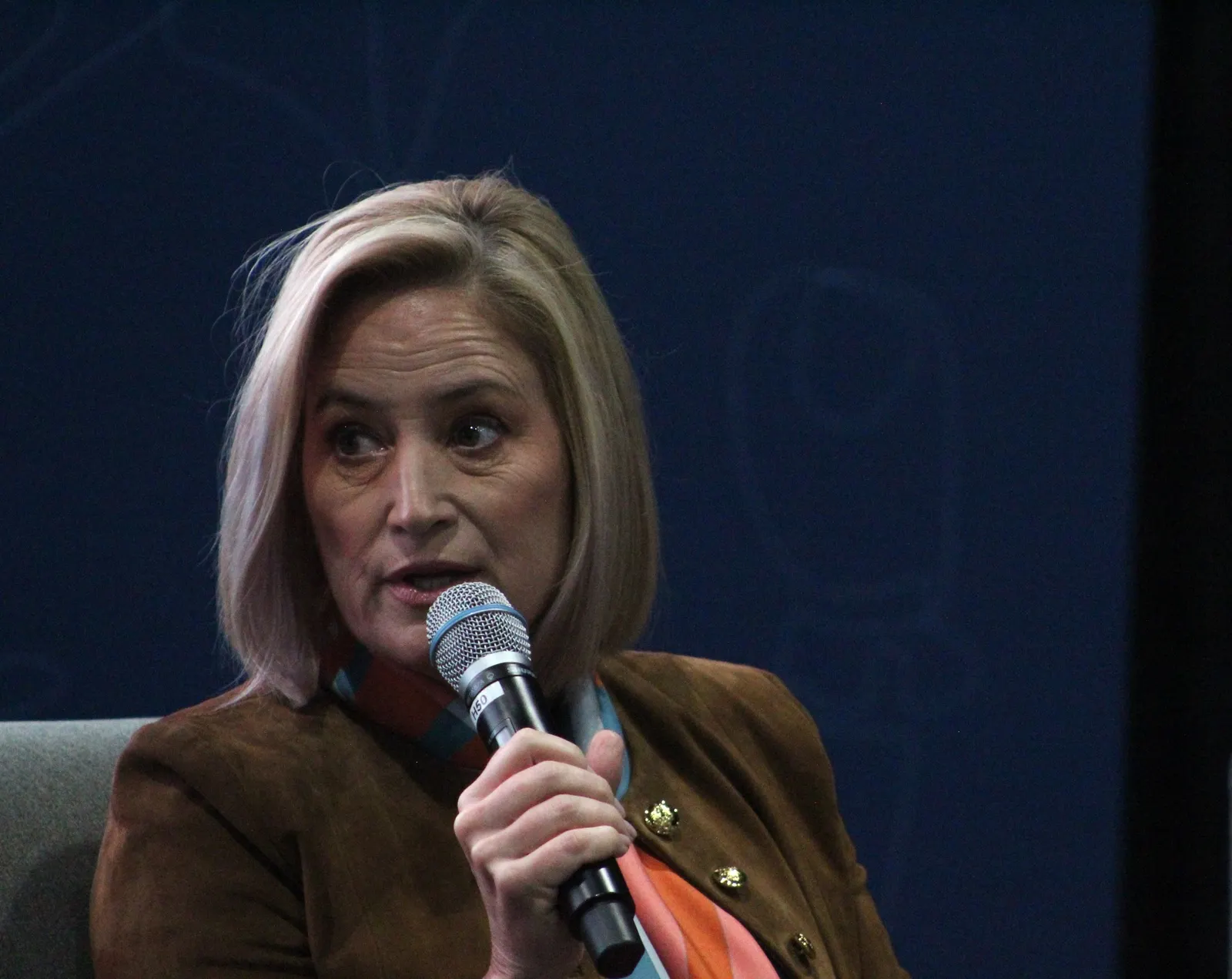
Insulet CEO Ashley McEvoy speaks at The MedTech Conference.
Elise Reuter/MedTech Dive, data from MedTech Dive
Hologic CEO Stephen MacMillan
MacMillan said AI has been helpful with the rise of 3D mammography, which creates more images than 2D mammograms. Looking through so many images can be fatiguing for radiologists. The company uses machine learning to distill the process down to “go look at slide 3 in the upper left quadrant instead of looking at hundreds of slides,” MacMillan said.
The company has started using AI in its breast imaging segment, but plans to roll it out to the rest of its businesses. For example, Hologic has developed a newer tool to support pap smears, which are still often done by cytologists looking at individual slides through microscopes. The company has digitized the process and uses machine learning to flag objects of interest for cervical cancer. Hologic received the FDA’s de novo authorization for the digital cytology system in 2024.
Olympus Chief Strategy Officer Gabriela Kaynor
Four years ago, Olympus started focusing on investing in its data and AI capabilities, but more geared toward the company’s medtech products, Kaynor said. That has culminated in a recent product launch for AI to support colorectal polyp detection, as part of a broader platform to use AI in endoscopy.
In the past two years, Kaynor said, Olympus has explored AI more for enterprise productivity. For example, Olympus built an internal AI tool to help with language translation, which can be a friction point.
Olympus is headquartered in Tokyo, and work is done in Japanese, English and German. Being able to translate data — which might be sensitive — without it leaving the company was a good use case for the technology, Kaynor said. Olympus has been piloting the tool, and the company is getting ready to launch it internally.
“This has been something that I think has reached, really, every corner of our company,” Kaynor said.
