



Blood tests that screen for cancer earlier are moving from the development stage to clinical adoption. Tests that identify cancer signals from DNA shed into the blood are intended to catch the disease before a person has symptoms, when it is more treatable.
Guardant Health has been at the forefront of early cancer detection efforts with its Shield blood test for colorectal cancer screening. The test won the Food and Drug Administration’s approval in 2024 for people age 45 or older who are not at high risk for the disease. The FDA emphasizes the test is not a replacement for colonoscopy, due to limited effectiveness in detecting Stage I cancer and precancerous lesions. A competing test from Freenome was approved by the FDA last month for the same indication.
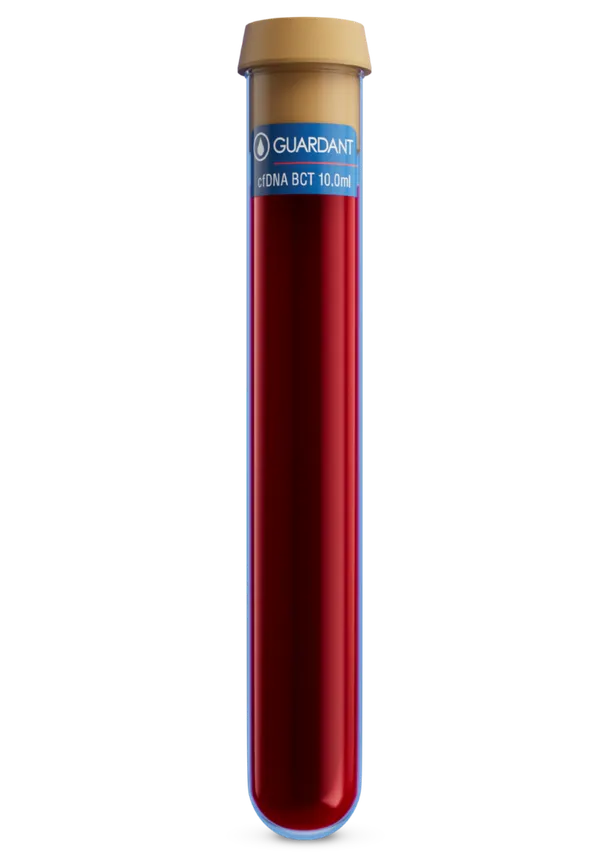
Guardant Health’s Shield in vitro diagnostic test detects colorectal cancer-derived alterations in cell-free DNA in the blood.
Permission granted by Guardant Health
Blood-based screening for colorectal cancer gained an endorsement this year from the American Cancer Society for patients who are not willing to get a stool test or visual exam.
Adding to the momentum, UnitedHealthcare, the largest private U.S. insurer, recently agreed to cover Shield for its enrollees.
Guardant is also expanding Shield into multicancer detection, following the FDA’s breakthrough device designation for the test in MCD.
Sam Asgarian, Guardant’s vice president of clinical development, discussed the company’s progress in blood-based colorectal cancer screening and multicancer strategy in a conversation with MedTech Dive.
Editor’s note: This interview has been edited for length and clarity.
MEDTECH DIVE: The Shield test for colorectal cancer is generating strong volume and revenue growth for Guardant. How is the test being used in clinical practice?
SAM ASGARIAN: Last year, 2025, was the first calendar year where it was out. We’re in the hundreds of thousands of people tested already. You have 54 million people who are unscreened or late to be screened right now, so we’re barely touching the surface.
The majority of the patients we are seeing screened are the previously unscreened. I think physicians are realizing if this person is doing colonoscopy, great. But if they’ve had hesitancy — I don’t know if that’s the right test for me, I feel fine — then they’re offering them Shield.
We’re seeing that data start to come in. We’re seeing physician satisfaction. We’re seeing patients really thankful, happy. We’re starting to see those stories. The goal is to grow the lab capability to where we can start getting into the millions of people tested.
Will you be able to quantify whether more people are getting screened because of the availability of Shield?
We’re trying to see, of the data that we’re getting and patient-reported outcomes of their test experience, how many more of the unscreened are getting screened. We hope to have that within the next year.
The other thing we’re doing is, when you’re a Shield patient and you’re positive, you do have to get the colonoscopy. The colonoscopy is what’s used to treat colon cancer. You could remove the lesions and the polyps.
We’re getting the majority of patients, over half, screened all the way [including colonoscopy]. That’s pretty phenomenal, because if they previously said no to colonoscopy, they’re a harder group to convince to get a colonoscopy. We want that number to keep getting higher and higher. We want it to be a robust study where we show that folks are getting fully screened when they’re positive. That’s another thing that we hope to have in the next year, in terms of data that we can report out.
In a New England Journal of Medicine study, the test missed a significant percentage of cancer cases (16.9%) and showed low sensitivity (13.2%) for detecting advanced precancerous lesions. Do you expect a next-generation Shield test can improve sensitivity, and what are your targets for improvement?
The number that was missed — that 16.9% — those were all Stage 1. They were early-stage. The precancerous lesions — pre-Stage 1 — the test had low performance.
The FDA didn’t approve [Shield] for precancerous lesion detection. It’s approved for colorectal cancer detection. We do want to invest more, and use more innovative science, to try to get that earlier-stage and that precancerous number up. That is a next-generation version of the test.
We’ve never stopped working. These are all lengthy processes. We have to submit a version to the FDA. We just got approval for what we call a higher-throughput version. That allows us to process more tests through the lab. We’ve already improved that aspect of it, and the performance is what we want to improve next.
We want something that’s better at Stage 1 detection. Then we want to get those precancerous lesions up. It is a limitation of a blood-based test. Precancerous lesions don’t shed into the blood as much as we wish they would. Sometimes they don’t shed at all in the blood. If we can get that number — to start with — to something in the high-teens, that’s an improvement to us, and that’s closer to some of the stool-based tests, too, that are in the 20s.
As you work to improve test sensitivity, where is the science leading, and what is your timeline for a next-generation test?
We invested in some new science over the past year. We want to work in the lab, make sure we get the assay right.
We look at DNA signals right now. We’re able to capture that. But there are other things that cells shed beyond DNA. They shed lipids. They shed proteins. They shed RNA. Can we look at some other metabolites of what’s being shed, some other markers, and see if we can capture those in the blood in combination with the DNA?
There are a lot of things that we’re doing to assess that. Some combination may get us the boost that we need.
It would still need FDA approval. The timeline grows as a result. I would say in the next year to year-and-a-half, if we’re successful in the laboratory, we could have something for the FDA that would get approved within that next 18-month timeline.
In multicancer detection, you’ve taken a different approach than Grail, whose Galleri test screens for a signal shared by more than 50 cancer types. What are your goals for Shield in multicancer detection?
Years and years ago, before the study for colorectal cancer, there was a need to decide, where do you want to point this technology? Because of the patient need, because of the growth in prevalence of colorectal cancer, it was pointed there first. But the intent was always to see how it worked in other areas.
It’s been really phenomenal now, since last October, to have the ability to produce a multicancer test that covers the most common cancers that people are diagnosed with and allows us to investigate how it’s performing. It’s 10 cancers, a combination of those like breast and colon that have screening and some that don’t, like pancreatic and ovarian.
If we understand how it works in these 10 specific cancers, we can absolutely expand it, and we may expand it down the line. But from a starting point, it made the most sense for us to go after the vast majority of patients who have to face these diagnoses, and potentially mortality risk.
It’s the same test to the patient and the physician. It’s the same blood draw, the same kit. It’s all the work in the background that we can do. We separate out the two tests, and they get two results back.
We hope to be producing more of that data for publications, FDA strategy, reimbursement potentially in the future, and then fine-tuning our own algorithm. We want to make performance across those cancers best as possible, too.
The FDA has decided to convene an advisory committee meeting next month to evaluate Grail’s Galleri test. Do you expect to also pursue FDA approval for the Shield multicancer test?
We’ve always wanted FDA approval for our screening solutions. So yes. Right now it’s a lab developed test, and it gives us the ability to keep doing research in R&D and gather real-world evidence on how the test is performing. We then would want to get toward a structured protocol and study for potential FDA submission down the road.
