



What You Should Know:
– New flagship research from athenahealth’s intelligence hub reveals a critical maturity milestone in healthcare AI: the shift from experimental admin tools to trusted clinical partners.
– A national survey of 501 clinicians and administrators found that 86% now feel comfortable delegating or sharing the responsibility of catching easy-to-miss details in patient records with AI.
– While adoption is surging—with 62% of practices now using four or more AI tools—interoperability remains a stubborn firewall, with nearly half of respondents struggling to access relevant data across fragmented systems.
athenahealth Research: New 2025 Data Shows Rapid Shift to AI-Enabled Clinical Decision Support
For the last three years, the healthcare AI narrative has been dominated by “burnout reduction”—using bots to automate the back-office drudgery of billing and scheduling. But according to new data released today by athenahealth, the industry has quietly crossed a massive psychological rubicon: doctors are now letting AI into the exam room.
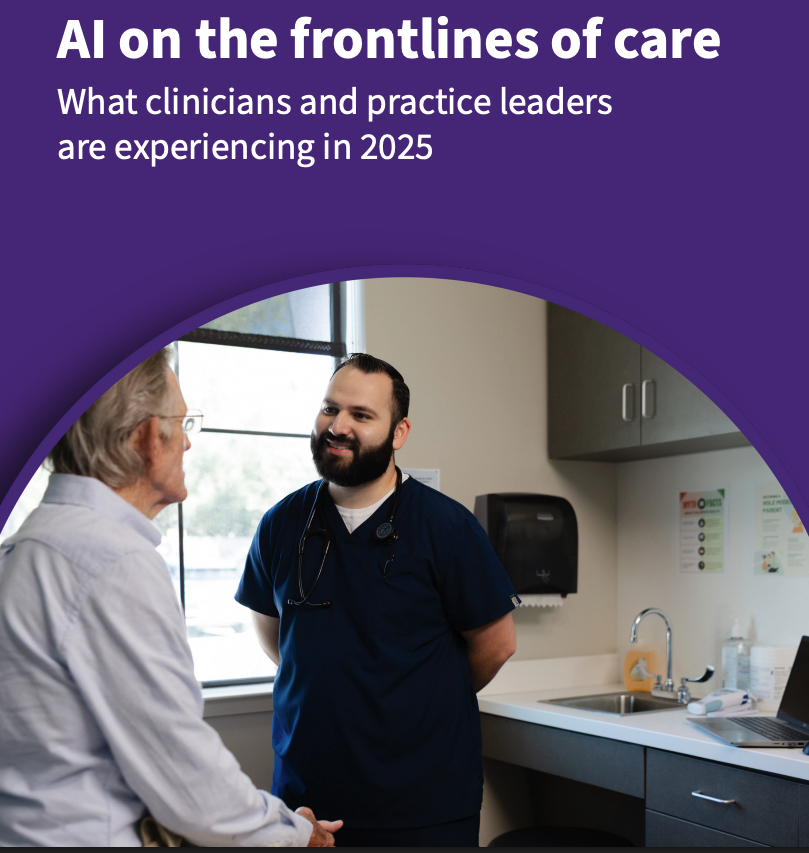
The research, titled “AI on the Frontlines of Care,” surveyed over 500 clinicians and practice leaders across the U.S.. The findings describe a sector where AI has graduated from a “nice-to-have” efficiency tool to a “strategic assistant” capable of improving clinical outcomes.
The Rise of the Digital “Second Opinion”
The most significant finding in the report is the high level of trust clinicians now place in AI for data synthesis. In a field governed by “do no harm,” this confidence is striking.
- 86% of respondents are comfortable with AI identifying easy-to-miss details in patient records, effectively treating the software as a safety net for human error.
- 55% see AI as crucial for consolidating disparate data, such as labs and imaging results, into a coherent view.
“Our research shows that among AI adopters, a growing majority… are starting to trust AI as a ‘second opinion’,” said Nele Jessel, MD, Chief Medical Officer at athenahealth. She notes that this shift allows clinicians to “illuminate patterns” and reach decisions faster, rather than just automating busy work.
From Experimentation to Infrastructure
Adoption rates suggest that AI is no longer a pilot project; it is becoming operational infrastructure. The survey found that 62% of practices used four or more AI-enabled tools in the last year.
The specific use cases reveal a “hierarchy of needs” in adoption. While documentation remains a primary driver—with 64% citing it for burden reduction —operational tools are becoming ubiquitous:
- 59% use AI-enabled self-scheduling.
- 47% use AI-supported intake or check-in.
- 36% use ambient documentation (AI scribes).
The report frames this evolution through an “AI Trust Ladder,” a model where clinicians move from an initial “First Win” (immediate relief from admin tasks) to a “New Normal,” where AI is fully embedded in clinical operations .
The “Interoperability” Firewall
Despite the optimism, the report identifies a critical throttle on AI’s potential: the fractured nature of healthcare data. AI models crave context, but they are often starving for it.
- 50% of clinicians find it difficult to locate relevant clinical information (PDF data cites 46% specifically struggle with discovery).
- 46% struggle with inconsistent data formats.
- Only 2% of physicians say they find it “not at all challenging” to access timely, relevant patient info across systems.
“Clinicians believe AI’s impact is still throttled by fragmented data,” the release notes. “When data is incomplete or outdated, AI becomes limited by the same barriers clinicians face on their own.”
The Human Dividend
Counter-intuitively, the ultimate benefit of this technology appears to be analog. The survey found that 69% of respondents believe AI helps clinicians engage more with patients. By offloading the cognitive load of data retrieval and synthesis, doctors are reclaiming the “human connection” that originally drew them to medicine.
