



In June, the Food and Drug Administration granted a breakthrough designation to Aidoc for a tool that uses generative artificial intelligence to interpret images and create reports. The feature, called First Read, is intended to detect multiple health conditions from chest X-rays and write reports for radiologist review.
The breakthrough designation, which gives a product access to priority review at the FDA, is notable as the agency is still determining its approach to medical devices using generative AI. Many questions still loom on best practices and patient safeguards for the technology.
MedTech Dive spoke with Aidoc CEO Elad Walach to learn more about how Aidoc’s First Read system works, and how the company is approaching safety and validation.
This interview has been edited for length and clarity.
MEDTECH DIVE: How does First Read work?
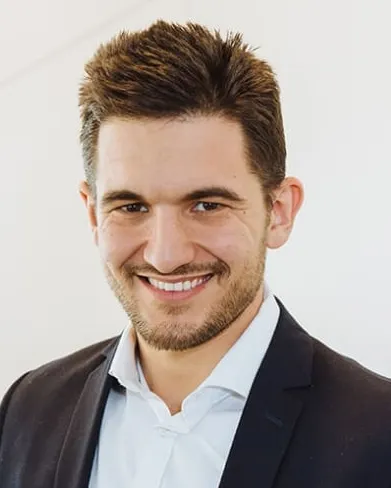
Aidoc CEO Elad Walach
Permission granted by Aidoc
ELAD WALACH: The thing about First Read, it’s one output, but it goes through a whole chain of models.
You have, first, the detection model. Then you generate things and put them into a report structure. It detects over 100 diseases on the detection side, and then drafts a complete report.
[This is] the first time we have an AI diagnostic that is end to end, so it’s a big moment.
The breakthrough device [designation] allows us to accelerate the time to market, while ensuring we still hit the same safety and quality guardrails. We think it’s necessary. Talking about safety, especially for devices that are this comprehensive, is important.
We can all upload an X-ray to ChatGPT and get a report, but it’s complex to do it right. You almost have to be as good as a human for the majority of cases, otherwise they would not use it; they would elect to do it by themselves. So the safety and accuracy threshold of these devices is high.
How do you achieve safety and accuracy when you’re dealing with multiple findings?
The biggest aspect is the model accuracy. In the past year we’ve raised over $300 million. It’s because training these models is very intense. There are no shortcuts. You just have to train a lot of data.
The second part is you have to be really good at validation. When you train these very big models, validation is becoming a difficult undertaking, because how do [we] validate across so many diseases? That is why we’re going through the breakthrough this way. It’s how do we validate this? How do we ensure safety of the model at the beginning and into adoption?
What’s next for you after the breakthrough designation?
Breakthrough device [designation] is a step, but it’s obviously not cleared yet, so we have to finish trials and get the [FDA] clearance.
It still is a plan in the next year and a half to cover practically every disease on CT and X-ray.
About a year ago I would never have told you that, because I wouldn’t have thought this possible … with First Read covering over 100 diseases in one fell swoop.
That’s the hope, that’s what we believe is possible. But I will say, on the flip side, we wouldn’t do anything that we think is unsafe. So, if it doesn’t meet the safety and quality threshold, even if it takes us another year or so, that’s the most important thing.
How does this fit into radiologists’ workflow? How are they interacting with this tool?
I would imagine this, as the name suggests, as a first read. So the AI [does a] first pass, and they review it and assess and change. Obviously, they’re still very much in the driver’s seat.
What do we want from AI? Improved safety and accuracy of reads, reduced time to diagnosis and improved capacity. It all comes back to the model accuracy point. If I write you a draft that is bad the majority of the time or enough cases, you’re going to lose trust and you’d rather start from scratch. But if I give you something really good, that is becoming the standard.
I’ve seen some concerns in discussions about how to make sure professionals don’t become less skilled or become too influenced by an AI’s suggestions. How are you thinking about these challenges?
I share those concerns. I think it’s very valid. In my mind, the biggest risk is automation. We should expect it to come and we need to mitigate that. In my mind, the mitigation, a lot of it’s around workflow. How do we ensure we have continuous human oversight and force the humans to have an action. I think that’s going to be key, at least until we gain more and more trust with the technology.
You need to know the model is really good at [some] types of cases, and less in [other] types of cases, and so transparency is important.
