



What You Should Know
- Boston-based cardiovascular medtech innovator Elucid closed an oversubscribed $55M Series D financing round, bringing its cumulative funding to approximately $185M.
- The round features participation from a new major, publicly traded medical device company—becoming Elucid’s fourth publicly traded strategic backer—alongside existing investors including IAG Capital Partners and Elevage Medical Technologies (a Patient Square Capital platform).
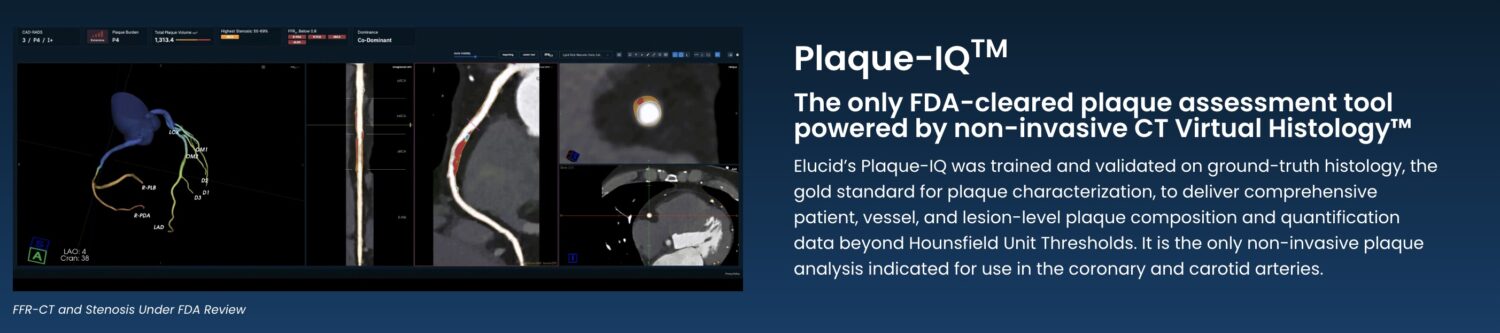
- Proceeds will accelerate the commercial rollout of Elucid’s unified non-invasive clinical platform, led by its flagship Plaque-IQ™ software and its BioIntegrated FFR-CT tool (currently under FDA 510(k) review).
- Plaque-IQ stands as the only FDA-cleared, non-invasive imaging software that quantifies high-risk plaque types and structural plaque composition across coronary and carotid arteries with accuracy validated directly against ex-vivo histopathology.
Linking Plaque Histopathology with Fractional Flow Reserve
Rather than treating arterial narrowing as a purely geometric blockage, Elucid uses artificial intelligence to convert standard CCTA scans into biological and hemodynamic intelligence. The software reconstructs 3D arterial models to evaluate vessel anatomy, plaque composition, and ischemia in a single non-invasive pipeline.
The fresh growth capital will fund commercial scaling and research milestones across its core platform:
- Commercialization of Plaque-IQ™: Expands clinical adoption of its FDA-cleared software, the only non-invasive platform capable of quantifying high-risk plaque tissue types—such as lipid-rich necrotic cores—with diagnostic accuracy validated directly against ground-truth histopathology.
- Launch Preparation for BioIntegrated FFR-CT: Prepares for broad commercial rollout pending U.S. FDA 510(k) clearance for its non-invasive fractional flow reserve (FFR-CT) capability. The tool calculates pressure drops across coronary lesions by combining fluid dynamics with underlying plaque morphology, matching the accuracy of invasive pressure-wire evaluations without requiring hospital catheterization.
- Unified Diagnostic Workflow: Integrates plaque tissue analysis and FFR-CT physiology into a streamlined reporting interface that embeds structured cardiovascular risk summaries into clinical diagnostic systems.
- Landmark Evidence Generation: Accelerates ongoing multicenter clinical trials to demonstrate how non-invasive plaque quantification alters downstream medical therapy, reduces unnecessary invasive diagnostic angiograms, and cuts major adverse cardiac events (MACE).
“Analogous to oncology’s shift from population-based, one-size treatment, Elucid is applying AI to integrate anatomy, biology, and physiology to bring personalized treatment to coronary artery disease management,” said Kelly Huang, PhD, Chief Executive Officer of Elucid. “Physician feedback indicating that our current platform can uniquely lead to better care decisions fuels our mission to predict and personalize the prevention of heart attacks and strokes.”
