



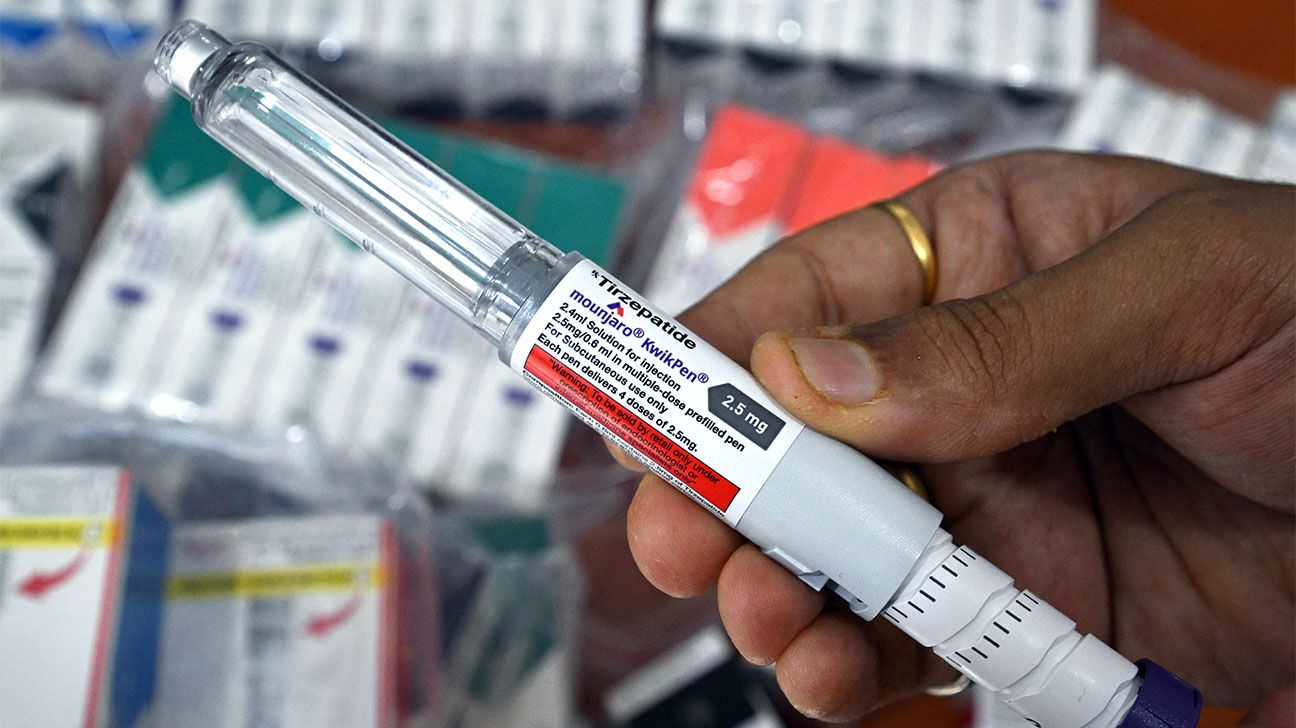
- GLP-1 weight loss medications containing tirzepatide (Mounjaro, Zepbound) can reduce heart-related health risks for people with serious heart conditions, according to new research.
- Experts say the heart health benefits are produced by the drugs’ ability to help people lose weight and control blood sugar levels.
- People using these medications should also maintain a healthy lifestyle, including daily exercise and a balanced diet, to maintain overall health.
Weight loss medications containing the active ingredient tirzepatide significantly reduce cardiovascular risks in people with serious heart conditions, according to new research.
Tirzepatide medications are usually prescribed to help treat type 2 diabetes.
According to a news release for the two studies, tirzepatide’s ability to manage blood sugar levels and promote weight loss delivers “meaningful cardiovascular benefits.” While prior research has established these benefits, their impacts on patients undergoing interventional heart procedures have not yet been extensively evaluated.
Notably, the researchers found a 62% lower risk of death among participants receiving tirzepatide who underwent a PCI procedure.
“GLP-1 agonists represent an important evolution in cardiometabolic care,” said SCAI President Srihari Naidu, MD, an interventional cardiologist, in the news release.
“Clinicians already recognize the benefits of glycemic control and weight reduction, but we are now beginning to understand how these therapies can improve outcomes in patients undergoing transcatheter cardiovascular interventions.”
Experts not involved in the new studies say the research supports earlier studies on the cardiovascular benefits of weight loss drugs.
“These findings are consistent with what we are seeing broadly that medications like tirzepatide are not just weight loss drugs but have meaningful cardiometabolic benefits,” said Kevin Shah, MD, a cardiologist and the program director of Heart Failure Outreach at MemorialCare Heart & Vascular Institute at the Long Beach Medical Center. “We do need prospective studies to validate the findings from these analyses.”
They identified adult participants with type 2 diabetes who received GLP-1 drugs containing tirzepatide or older medications with the active ingredient dulaglutide at the time of their PCI procedure.
The researchers did not compare tirzepatide drugs with medications that contain the active ingredient semaglutide, such as Ozempic and Wegovy.
In all, the researchers examined the medical records of 1,281 study participants. One month after PCI, they reported that the participants who used tirzepatide drugs experienced lower rates of major adverse cardiovascular events, such as:
They noted there was no difference in rates of stroke among participants using tirzepatide drugs and those using dulaglutide medications.
One year after PCI, researchers observed reductions in MACE, myocardial infarction, and heart failure exacerbation, remaining consistent after one year. There were also further reductions in mortality, stroke, and cardiac arrest at one year.
“The study adds on additional data to what we’ve already previously known about GLP-1 containing agents: these drugs hope to reduce risk for cardiovascular complications from obesity,” said Yu-Ming Ni, MD, a cardiologist and lipidologist at MemorialCare Heart and Vascular Institute at Orange Coast Medical Center in Fountain Valley, CA. Ni wasn’t involved in the study.
“This patient population in this study is automatically higher risk because they need an intervention for their conditions,” Ni told Healthline. “Consequently, seeing a reduction in risk of cardiovascular events is promising, albeit not surprising.”
Jackie DesJardin, MD, a cardiologist and an assistant clinical professor of medicine at the University of California San Francisco’s Division of Cardiology, cautioned that there may be more to these results than simply the medications. DesJardin wasn’t involved in the study.
“The dramatic reductions seen here, more than 50% lower heart attack risk within just one month, are simply too large to be explained by the drug alone,” she told Healthline.
“Tirzepatide is new and expensive, and the patients who receive it tend to be more affluent and better connected to care. Despite the author’s best attempts to adjust for these factors, these socioeconomic differences could easily be driving some of the differences in outcomes,” she noted.
In a second study, researchers from the University of Texas Medical Branch, Houston, TX, used the TriNetX database to identify adults with obesity who underwent TAVR from January 2020 to January 2025.
They grouped the participants based on whether or not they were prescribed tirzepatide medications.
According to a news release, participants who did not receive tirzepatide “experienced worse outcomes over time, with lower event-free survival.”
They said the participants who didn’t take tirzepatide also faced a 54% higher risk of hospitalization for acute heart failure.
They added that patients who didn’t take tirzepatide experienced major adverse cardiovascular events 44% more frequently.
Researchers, however, noted that they observed no significant differences between groups in rates of ischemic stroke, acute myocardial infarction, and acute kidney injury.
Cheng-Han Chen, MD, an interventional cardiologist and the medical director of the Structural Heart Program at MemorialCare Saddleback Medical Center in Laguna Hills, CA, said this new research provides valuable information for medical professionals. Chen wasn’t involved in the studies.
“These results add to our rapidly growing evidence of the beneficial effects of GLP-1 agonists across a broad range of cardiometabolic conditions,” he told Healthline.
Recent research has shown that weight loss medications that contain tirzepatide or semaglutide have numerous health benefits.
An August 2025 study reported that both types of GLP-1 drugs can reduce the risk of hospitalization and death in people with a common type of heart failure.
A February 2026 study stated that the pill version of the semaglutide drug Wegovy can help lower the heart failure risk for people with type 2 diabetes.
Experts say the heart health benefits from GLP-1 drugs are derived from the medications’ ability to help people lose weight and manage blood sugar levels, among other factors.
“GLP1 agents such as semaglutide and tirzepatide promote weight loss, reduce insulin resistance, and reduce liver fat,” said Ni. “All of these biological improvements have been shown to [reduce] the risk for heart disease.”
“Improperly controlled diabetes can hurt the heart in many ways,” said Chen. “Excess blood sugar increases inflammation in the blood vessel walls, leading to plaque buildup, which can cause heart attacks and heart muscle damage. The excess blood sugar can also lead to dysfunction of the heart muscle directly and cause it to become stiffer and pump blood less efficiently.”
“Tirzepatide works by mimicking two natural gut hormones that are released after eating, leading to more weight loss and better control of the major drivers of cardiovascular disease: blood sugar, blood pressure, and cholesterol,” added DesJardin.
“There is also emerging evidence that these medications may have direct effects on the heart and blood vessels, reducing inflammation, helping blood vessels relax, protecting heart muscle cells, and slowing plaque buildup in arteries.”
Experts say it’s important for people taking tirzepatide and semaglutide drugs to realize that these medications simply suppress a person’s appetite.
“[GLP-1 drugs] are effective, but these medications work best as part of a broader plan of lifestyle changes,” Shah told Healthline. “Patients should be monitored closely for side effects and determine long-term goals on this medication class.”
Ni said that weight loss medications are meant to be a short-term solution while lifestyle habits produce long-term results.
“I advise patients to use these medications in conjunction with a broader lifestyle change goal,” he said.
“Even if my patients are using this for diabetes or cardiovascular prevention, it still is meaningful to modify diet, physical activity, exercise, sleep patterns, and other lifestyle measures to improve overall health. I find my patients that are successful at changing the way they live to be healthier can get off these medications easier down the road and not regain the weight.”
