



What You Should Know
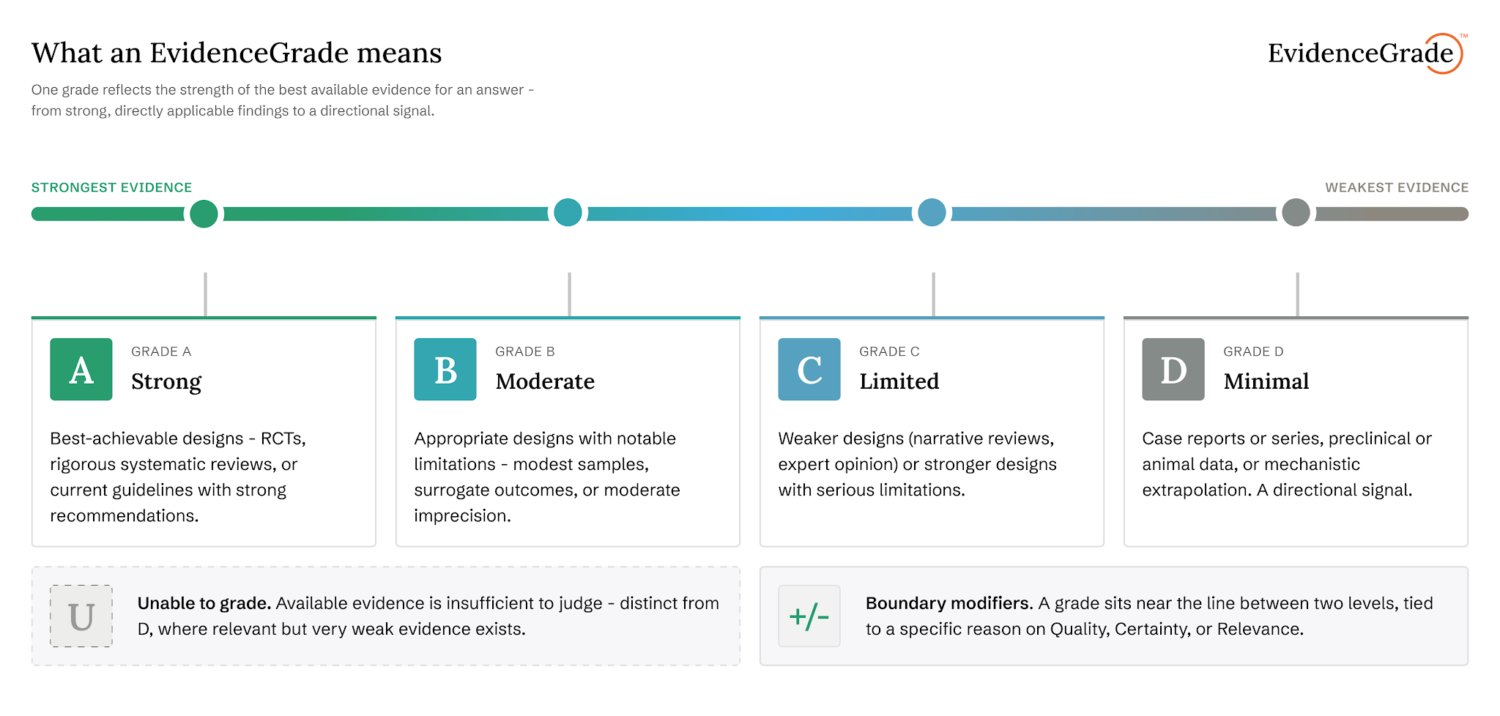
- Medical AI leader OpenEvidence has announced the commercial launch of EvidenceGrade, a new system capability that scores and visualizes the clinical certainty of cited medical literature in real time.
- The feature directly targets a dangerous AI limitation: standard models tend to gloss over differences in source quality, treating small, observational studies with the same weight as randomized, blinded, placebo-controlled trials.
- Built by a cross-functional team of physicians and computer scientists, EvidenceGrade adapts the GRADE framework—the methodology underlying the World Health Organization (WHO) and Cochrane guidelines—to function at point-of-care speeds.
- The technology scales across edge cases where formal medical syntheses are unavailable, extending automated, structured evidence grading to the vast majority of clinical questions that lack official guidelines.
- This deployment reinforces OpenEvidence’s status as a dominant clinical decision support tool, utilized daily by a significant majority of practicing verified U.S. physicians.
Scaling the GRADE Framework: Automation with Clinical Rigor
The architectural strategy behind EvidenceGrade rejects black-box algorithms in favor of established, consensus-driven medical standards. Developed by an integrated team of lead physicians and software engineers at OpenEvidence, the novel feature builds directly upon the foundational GRADE (Grading of Recommendations Assessment, Development and Evaluation) framework. This is the exact, rigorous methodology that anchors the World Health Organization (WHO), Cochrane systematic reviews, and the vast majority of major international clinical practice guidelines.
By automating this framework, OpenEvidence calculates data certainty instantly, matching the rapid pace and massive scale that clinicians require during active point-of-care encounters. Rather than leaving physicians to manually investigate historical publication versions, sample sizes, or author biases, EvidenceGrade surfaces a clear visual of source strength directly within the clinical interface.
This transparency is critical because traditional, expert-led evidence reviews—while invaluable—are inherently limited by human bandwidth. Formal Cochrane reviews and updated clinical guidelines cover only a small fraction of the complex, nuanced questions that cross-functional care teams manage in daily practice. EvidenceGrade fills this gap by scaling structured, transparent evidence grading across the entire platform, including the thousands of everyday clinical questions for which no formal appraisal has ever existed.
“Not all evidence is equally certain, and when a clinician acts on an answer, it’s imperative they understand how much weight the underlying evidence can bear,” stated Samuel Finlayson, MD, PhD, Senior Vice President of Medical AI at OpenEvidence. “Expert research appraisal teams do invaluable work, but they can’t cover every question that comes up in everyday practice. We built EvidenceGrade to extend their methods to as many questions as possible.”
Overcoming Procurement Drag via Trusted Clinical Domain Expertise
The commercial rollout of EvidenceGrade cements OpenEvidence’s position as the fastest-growing and most trusted clinical decision support tool in the United States healthcare ecosystem. The company has bypassed traditional technology procurement hurdles by aligning its platform directly with the workflows of leading medical societies. Through a strategic partnership with Cochrane, OpenEvidence surfaces gold-standard systematic reviews directly within the provider’s chart view.
Concurrently, the company has partnered with the American Academy of Otolaryngology–Head and Neck Surgery Foundation (AAO-HNSF) to pioneer a new approach for keeping clinical practice guidelines dynamically updated as new peer-reviewed data emerges.
Because OpenEvidence grounds every single response in peer-reviewed medical literature and provides unbroken, source-cited traceability back to the original text, hundreds of thousands of verified healthcare professionals leverage the tool daily to guide high-stakes decision-making.
