



Editor’s note: This is the seventh article in a series of stories profiling medtech companies that are changing the field of robotic surgery. Read the other profiles here.
MMI built its microsurgery robot to perform intricate procedures with greater precision than the human hand can provide.
The robot helps surgeons reconnect and repair tiny structures such as blood and lymphatic vessels that can be less than a millimeter in diameter.
“When you think about surgery that’s small, the limitations of the human body are pretty real,” said CEO Mark Toland. “The robot comes in and what we call ‘democratizes’ vessel size.”
MMI’s initial Food and Drug Administration authorization, a de novo classification in 2024, made the Symani system the first surgical robot available in the U.S. for reconstructive microsurgery. An additional FDA clearance last December expanded the system’s capabilities to include soft tissue dissection.
The Symani system has been used to transplant skin, bone and tissue from one part of the body to another after traumatic injury. Procedures to treat lymphedema, an abnormal buildup of lymphatic fluid that can occur after cancer treatments, are a primary focus for the robot’s specialized technology.

MMI CEO Mark Toland
Permission granted by MMI
“We’re doing breast reconstruction. We’re doing lymphatic repair across the body. We’re doing transplants for patients who have suffered from extremity trauma, typically from manufacturing accidents,” said Toland. “We’ve even done wounded warriors who are coming back from battle. So it’s a pretty rewarding technology, because it’s enabling physicians to reconstruct the body in a way that they may not have been able to do with their human hands before.”
Microsurgery is a technique that is performed under an operating microscope during open surgery. With miniaturized instruments — the world’s smallest, according to the company — MMI’s robot addresses the physical challenges of procedures that require the steadiest touch. As the surgeon manipulates handheld controllers, the system filters out tremors and translates the intentional hand and wrist motions into scaled-down robotic movement of the instruments. The surgeon selects the motion scaling factor, from 7x to 20x.
The motion scaling feature differentiates Symani from Intuitive’s da Vinci robot and other soft tissue surgical platforms coming to market, said Bohdan Pomahac, a surgeon who leads MMI’s PRECISE post-market trial.
“What’s very unique about this technology is the scaling,” said Pomahac, chief of plastic and reconstructive surgery and director of the face transplant program at Yale Medicine. “The advantage of the system and technology is that it’s intended to be a high precision tool.”
That level of control enables surgeons to perform procedures that otherwise might not be feasible, Pomahac said. The PRECISE study will follow up to 455 patients to evaluate the robot’s performance in reconstructive and lymphatic repair procedures.
With Symani designed for open surgery across multiple specialties, Toland sees the robot’s market opportunity as vast. Forty million open surgical procedures are performed yearly in the U.S., four times the number of laparoscopic procedures, he said.
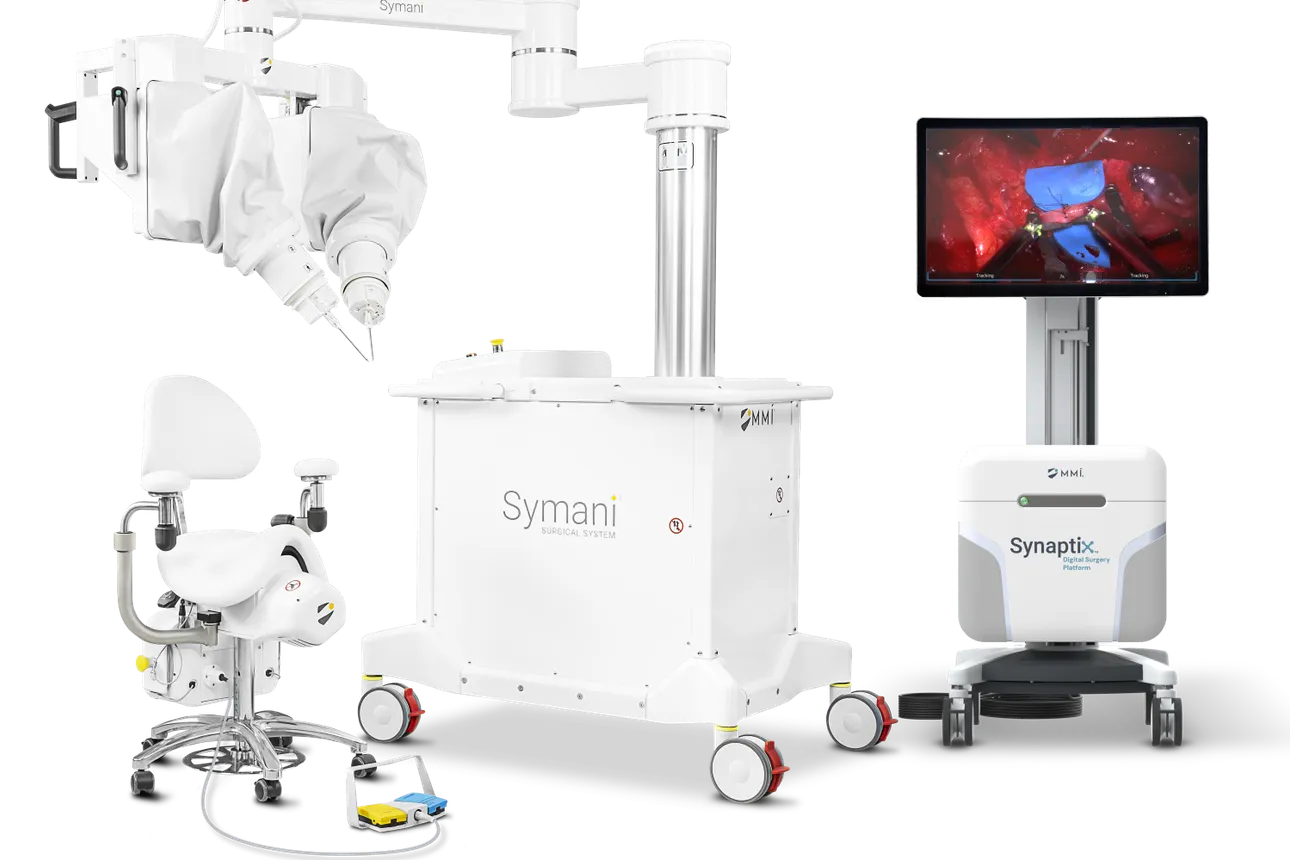
MMI’s Symani surgical system and Synaptix digital platform can be moved between operating rooms.
Courtesy of MMI
Most da Vinci procedures are in the abdomen and pelvis, typically focusing on large organs like the prostate, gallbladder and colon. The Symani system, by contrast, is used in microsurgery throughout the body, Toland said.
“Laparoscopic stuff is in the belly,” said Toland, a medtech industry veteran who joined MMI in 2021. “We’re kind of doing all the other stuff, which is a great situation to be in, because you’re really not ever competing against the 800-pound gorilla, being Intuitive.”
Microsurgery, he added, “includes a lot of different applications associated with putting the body back together.”
Reconstructive head and neck procedures for cancer patients are a more recent area of expansion for MMI in the U.S. The Symani robot has also supported cochlear implants, ophthalmic procedures, intracranial brain surgery, liver transplantation and spine tumor removal.
“We’re trying to move the line of complexity for all physicians who want to do microsurgery, or supermicrosurgery,” Toland said. Surgeons have used the robot in about 3,000 procedures to date.
“This isn’t just surgery. This is pushing the boundaries of medicine.”

Alzheimer’s initiative
Last month, the company announced that Symani was used to treat a patient with Alzheimer’s disease in the REMIND study. The trial will evaluate whether restoring lymphatic drainage pathways in deep cervical lymph nodes can help clear neurotoxins that researchers believe contribute to the progression of the disease.
The multi-center, FDA-approved investigational device exemption study will enroll 15 patients who will be followed for 12 months after the procedure.
“This isn’t just surgery,” said Toland. “This is pushing the boundaries of medicine.”
MMI has six clinical trials that are enrolling patients this year. “We have clinical trials for all of our applications, to show that the robot is better than the human hand,” Toland said.
MMI is backed by prominent investors that include Fidelity Management and Research, Andera Partners, Deerfield Management, RA Capital and Wellington Partners. All told, the company has raised $270 million to support Symani’s development, said Toland, who is a managing director at BioStar Capital, another MMI investor.
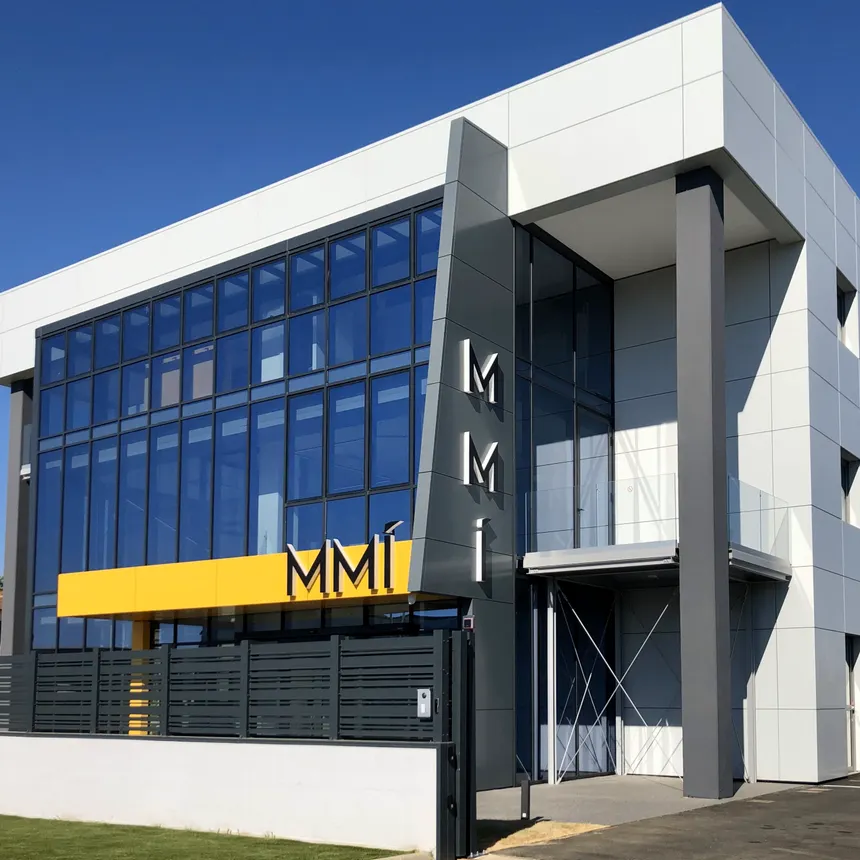
MMI’s Innovation and Operations Center of Excellence in Pisa, Italy, opened in 2022.
Courtesy of MMI
The company has offices in Jacksonville, Florida, and Pisa, Italy, where it was founded in 2015 and where it manufactures the Symani systems.
For now, MMI remains the only company with a commercially available robot in the U.S. designed specifically for microsurgery, though a potential competitor, Microsure, could be on the horizon with its MUSA-3 system, which recently received the CE mark in Europe.
“We’re the only crazy ones out there right now,” said Toland.
