



What You Should Know
- The Problem: A new JLL report reveals a “satisfaction gap” for frontline workers (retail, healthcare, labs). While their facilities support productivity, they fail on human-centered needs like wellbeing and flexibility.
- The Paradox: Frontline workers report higher burnout (44%) than office workers, yet have similar intentions to stay—often due to a lack of other options rather than loyalty, creating a “trapped” workforce.
- The Fix: The report calls for a strategy pivot: prioritizing schedule flexibility, upgrading physical environments (acoustics/ergonomics), and closing the massive AI training gap (only 52% of frontline staff have access vs. 70% of office staff).
JLL Report: 47% of Frontline Workers Demand Flexibility, but AI Training Gaps Persist
A new report from JLL, titled The Forgotten Workforce, suggests that this neglect is becoming a liability. The Workforce Preferences Barometer surveyed over 3,400 frontline workers across 26 markets and found a fundamental disconnect. While banks, labs, and retail stores are often “purpose-built” for operational efficiency, they are failing the humans inside them. The result is a workforce that is productive, but deeply unhappy.
“Employers that smartly invest in workplace design… can create high-performance work environments that will support all employees,” said Peter Miscovich, Global Future of Work Leader at JLL. But currently, that investment is lopsided.
The “Functional” Trap
The data highlights a distinct irony in facility design. Frontline workplaces are actually great at the basics.
- 72% of workers say their workplace supports productivity.
- 70% say it helps them serve customers effectively.
However, only 38% report being “very happy,” compared to 42% of office workers. The issue isn’t the equipment; it’s the environment. Frontline workers consistently scored their workplaces lower on “human-centered” aspects like socialization, cultural immersion, and professional development.
“We found fundamental misalignments between the design of their workplace and frontline worker’s more fundamental needs,” notes Flore Pradère, Research Director at JLL.
The Flexibility Divide
If the office worker’s currency is “location,” the frontline worker’s currency is “time.” With one in three frontline employees working outside standard hours, schedule flexibility has become the top quality-of-life demand.
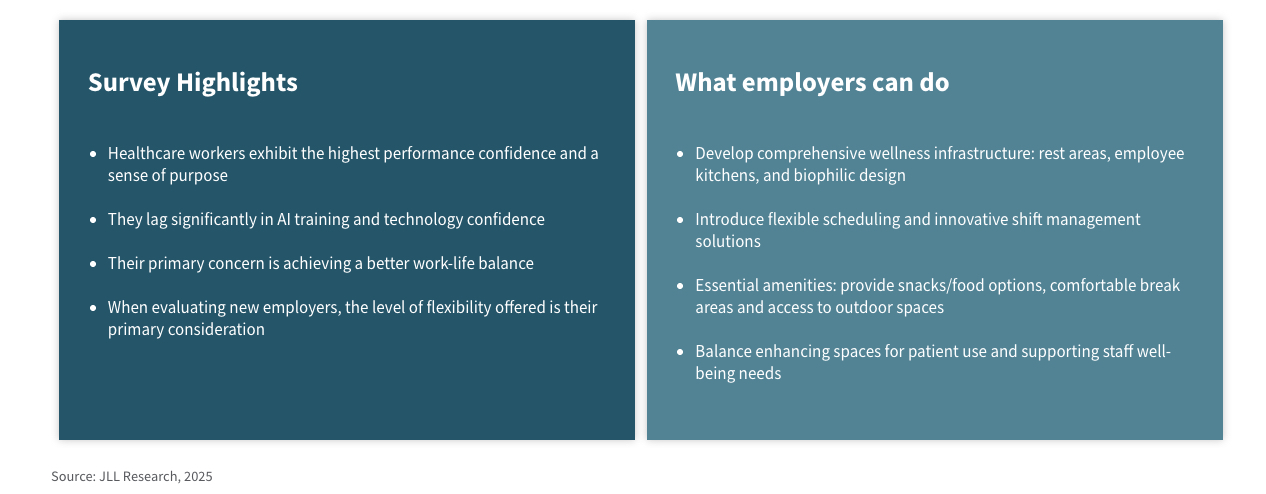
The report reveals a stark gap: 47% of frontline workers want flexible scheduling, but access is spotty at best. In healthcare, the disparity is glaring: 52% want flexibility, yet only 29% have it. “Business leaders have an opportunity to rethink the role of the workplace,” says Dr. Paul Morgan, Global COO at JLL. The solution isn’t necessarily remote work (impossible for a nurse or barista), but “adaptive workplaces” that offer digital shift management and autonomy over hours.
The Burnout-Retention Paradox
Perhaps the most alarming finding is the “Burnout-Retention Paradox.” Frontline workers report significantly higher burnout (44%) than office peers (39%). Yet, they are not quitting at higher rates.
This is not a sign of loyalty; it is a sign of being trapped. JLL’s analysis suggests these workers may have fewer options to change circumstances. “Those experiencing high burnout feel significantly less empowered and more isolated,” Pradère adds. This creates a “zombie workforce”—employees who stay because they have to, but whose engagement and psychological safety have collapsed.
The AI Training Gap
As automation enters physical spaces, a new divide is emerging. While 70% of office workers have access to AI training, only 52% of frontline workers do.
This lack of investment turns AI from a tool into a threat. Without training, frontline staff view automation as a replacement risk rather than an empowerment tool. To future-proof operations, JLL argues for “AI-ready learning environments”—dedicated physical spaces within factories and branches where staff can upskill on the very machines changing their jobs.
